Pinterest SEO: How I Realized Pinterest Isn’t a Social Media Platform
Pinterest SEO is a topic I ignored for years — and it cost me. I remember the exact moment I realized I had been doing everything wrong.
It was 7 a.m. I opened my laptop with a cup of coffee in my hand, like every morning, and the first thing I checked was Pinterest analytics. Three weeks earlier I had published a pin I considered my best work. Beautiful design. Clever title. I had poured hours into it.
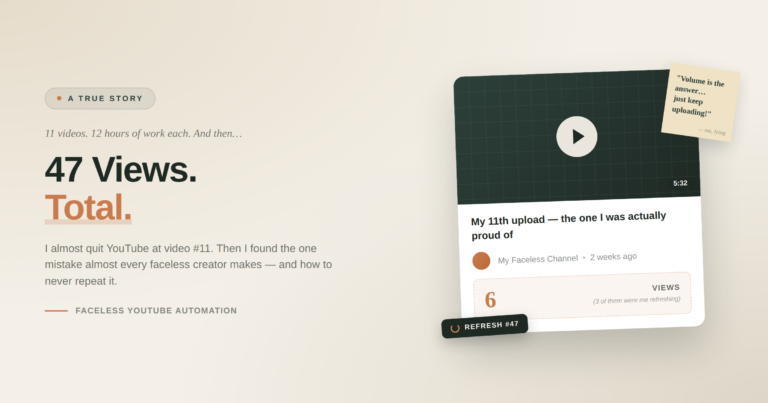
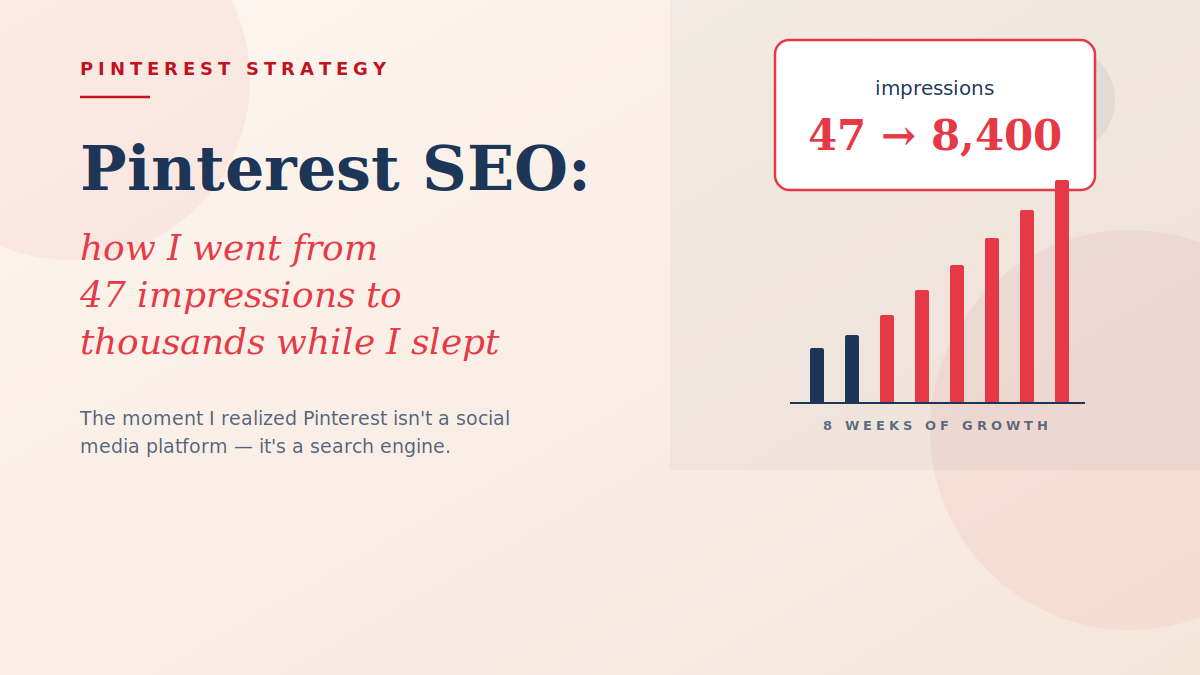
It had 47 impressions. Forty-seven.
Next to it, in the same table, sat a pin I had thrown together two months earlier. Ugly, honestly. A design I’d be embarrassed to show today. But the number beside it was growing every single day.
8,400 impressions. 312 clicks. And it was growing while I slept.
Why a “Pretty Pin” Means Nothing Without Pinterest SEO
For weeks I tried to understand why. I studied them side by side like I was searching for the difference between two nearly identical photographs. Colors? Font? Time of posting? Day of the week?
None of it.
And then, one evening, while rewriting the title of my “failed” pin for the third time, something clicked. I opened Pinterest. I typed in the topic the pin was about. And something happened that stopped me cold.
My pin didn’t appear anywhere. But at the top of the results, something else appeared — small grey bubbles with words inside them. Words that people actually search for. Words I had never used.
And that’s when I understood the truth most creators never discover: Pinterest isn’t a social media platform. Pinterest is a search engine.
That one sentence changed everything for me.
Pinterest SEO Changes the Way You Think About Content
Because once you grasp it, the entire picture shifts. You stop asking “how do I make a prettier pin?” You start asking something far more important: what are people actually searching for the moment they open Pinterest?
My “failed” pin didn’t fail because of the design. It failed because I had written a title that sounded clever to me. The other pin, the ugly one, had accidentally hit a phrase that thousands of people type into the search bar every week. And while I was sleeping, while I was doing other things, while I was just living my life — Pinterest kept showing it, again and again, to people who were looking for exactly that.
That was the moment I stopped making pins and started building assets.
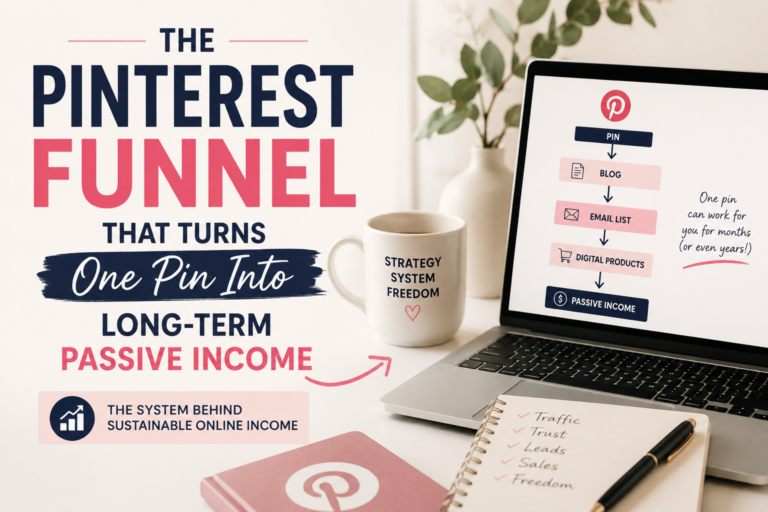
Because that’s what’s really happening here. A post on Instagram lives for twelve hours. A TikTok, if it’s lucky, two or three days. But a pin that speaks Pinterest’s language clearly — one that uses the right words, in the right places, connected to the right content — that pin can keep working for months. For years.
And here’s what hit me hardest: you don’t have to be the biggest. You don’t need thousands of followers. You don’t have to post every day. You just need to understand the system.
The Question Pinterest SEO Answers
A system that answers one question Pinterest is asking over and over again:
“Which pin best solves what this person is searching for?”
Once that finally clicks, everything else falls into place. You understand why some titles attract clicks and others don’t. Why some boards become traffic magnets while others sit like digital drawers nobody opens. Why two pins can lead to the same article, but one brings thousands of visitors and the other brings silence.
The Layers Most People Never Uncover
But here’s the problem. Most people I know stop digging right here. They learn Pinterest is a search engine, nod their head, and keep doing the same things. Pretty design. Clever title. Hope.
And keywords are only the first layer. Beneath them is keyword research — but not the boring, corporate kind. Pinterest’s own kind, the kind that uses the platform’s built-in tools to show you exactly what people are searching for right now. You can read more about how search engines interpret content in Google’s SEO Starter Guide — the principles are surprisingly similar.
Beneath that is the structure of titles. Then the formula for descriptions. Then the logic of boards as SEO signals. Then the way Pinterest distributes new pins — gradually, over months — which means a pin that “fails” in week one can explode in month three.
All of it is a system. And once you set it up, it stops feeling like work and starts running like a machine.
That “failed” pin of mine? It never took off. But the ones I made after I understood how Pinterest actually thinks — those are still bringing in visitors today. Some are over a year old. Still working. While I sleep.
That’s what Pinterest can become, once you stop working for it and start working with it.
📌 If you want to learn the whole Pinterest SEO system — from researching the keywords people actually type, to the structure of titles, descriptions, boards and a sustainable publishing strategy — it’s all broken down in the Pinterest SEO Blueprint. Step by step, no guessing.