How to Start a YouTube Channel When You Feel Like a Fraud: The Imposter Syndrome Nobody Talks About
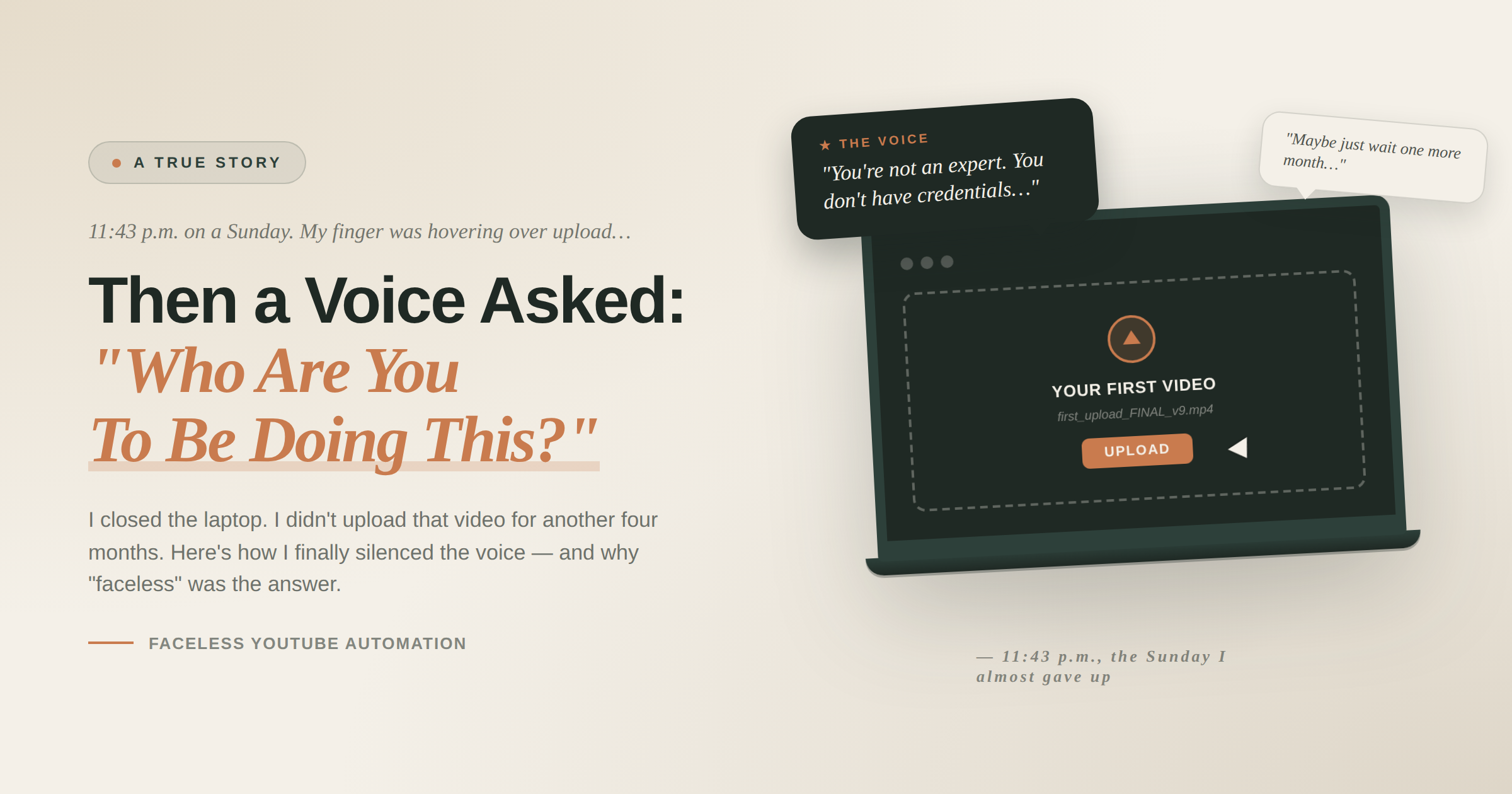
There’s a specific kind of voice that lives inside the head of almost every aspiring creator. Mine showed up the loudest at 11:43 p.m. on a Sunday, when I was about to upload my first YouTube video after months of preparation.
I had everything ready. The script was solid. The voiceover was clean. The thumbnail looked good. My finger was literally hovering over the upload button.
And then the voice spoke.
“Who are you to be doing this?”
“You’re not an expert. You haven’t made any money yet. You don’t have credentials. You don’t have a brand. Real creators have years of experience. Real creators look the part. Real creators don’t sit in a small apartment at midnight pretending they know things.”
I closed the laptop.
I didn’t upload that video for another four months.
If you’ve ever felt that same voice — that quiet, vicious certainty that you’re somehow not qualified, not ready, not enough — I need you to read every word of what’s coming next. Because I spent years believing that voice was telling me the truth. And it cost me opportunities I’ll never get back.
This is the story of how I finally figured out where that voice came from, why it was lying to me the whole time, and what changed when I stopped listening to it.
The Real Reason We Feel Like Frauds
For the longest time, I thought imposter syndrome was a self-confidence problem. I thought I needed to do affirmations in the mirror, or read another book about mindset, or wait until I “felt ready.”
I was wrong.
Imposter syndrome isn’t a confidence problem. It’s a comparison problem. And until you understand the difference, no amount of motivational quotes will fix it.
Here’s what I mean. When you sit down to make something — a video, a business, a piece of art, anything — you’re not actually comparing yourself to a fair baseline. You’re comparing your messy, unfinished, behind-the-scenes self to the polished, edited, public-facing version of someone who’s been doing this for ten years. Your Day 1 against their Year 10. Your raw draft against their final cut.
And then you feel like a fraud. Of course you do. You’re playing a rigged game with yourself as the loser.
The faceless creators I admire most? They felt exactly the same way at the start. Every single one. The difference isn’t that they were more confident. The difference is that they understood something most beginners never figure out: the feeling of being a fraud doesn’t go away when you get good. It goes away when you decide to ignore it long enough to get good.
The Four Months I Lost to a Single Sentence
I want to be really honest about what those four months cost me.
In the time between when I closed the laptop and when I finally uploaded my first video, I wrote nine more scripts that never saw the light of day. I downloaded three different editing programs and never finished a project in any of them. I joined two paid courses, watched the first module of each, and never returned.
I told myself I was “learning.” I was researching. I was preparing. I was getting ready.
I wasn’t. I was hiding.
Hiding is what imposter syndrome wants from you. It doesn’t want you to fail publicly — that would prove the voice wrong, eventually. It wants you to never start. Because as long as you don’t start, the voice gets to keep being right. The fantasy of who you could be stays intact. The risk of who you actually are never gets tested.
And here’s the cruelest part: the longer you hide, the more “expertise” you accumulate without ever shipping anything. You become deeply educated and completely invisible. You know more about your niche than half the channels actually winning in it — and you’ve made nothing.
That was me at month four. Sitting on more knowledge than 90% of the channels I was envious of, and somehow producing less than a teenager with an iPhone.
The Question That Broke the Spell
What finally got me to upload wasn’t a motivational video. It wasn’t a course. It wasn’t a coach.
It was one question, asked by a friend over coffee.
She wasn’t even in my industry. She knew nothing about YouTube. I was telling her — for the hundredth time — about all the reasons I wasn’t ready to start my channel yet. I needed more research. I needed better equipment. I needed to feel more confident about my niche. I needed —
She interrupted me. And she asked:
“Who decided you have to be ready?”
I didn’t have an answer. I literally sat there for ten seconds trying to think of one.
I had been waiting for permission. From who, exactly? From some imaginary committee that would tap me on the shoulder and tell me, yes, you may now begin. From an authority that doesn’t exist. From a feeling that was never going to arrive on its own.
The most successful faceless creators on YouTube right now? Nobody gave them permission either. They just started before they felt ready, and they used the act of starting to become ready. The order was: do, then feel ready. Not: feel ready, then do.
I uploaded the video that night. It got 38 views. It wasn’t a masterpiece. But it broke a spell I’d been living under for four months.
What I Learned in the First Year of Showing Up Anyway
After that night, I forced myself to follow one rule: when the voice came back — and it came back constantly — I would notice it, name it, and keep working anyway.
Here’s what I learned along the way. I’m sharing this not because it’s groundbreaking, but because I wish someone had told me earlier.
The audience doesn’t care about your credentials. They care whether you solve their problem. Nobody watching a faceless YouTube video about budgeting checks the creator’s MBA. They check whether the video helps them stop overspending on Friday nights. You don’t need to be the world’s leading expert. You need to be one chapter ahead of the person you’re helping.
Imposter syndrome gets louder when you grow, not quieter. I assumed reaching 1,000 subscribers would silence the voice. It got louder. Then I assumed 10,000 would. Same. The voice scales with the stakes. The trick isn’t waiting for it to disappear. The trick is learning to hear it and shrug.
Faceless is a gift, not a workaround. When I finally stopped needing to be on camera, half the imposter syndrome disappeared with it. The voice that said “who are you to be doing this” loses most of its power when you remove the “you” from the equation entirely. The work speaks. The information speaks. The narration speaks. Nobody is looking at your face wondering if you deserve to be there — because there’s no face to question. That alone is worth more than any course.
The first video is the only one that matters. Not because it’s good. It almost certainly won’t be. But because it crosses a line you can never uncross. Before it, you are someone who talks about starting a channel. After it, you are someone who has a channel. Those are two completely different identities. And the only thing standing between them is a single upload.
The Truth Nobody Told Me
If I could go back and sit with myself at that kitchen table at 11:43 p.m., I would say one thing:
The voice telling you that you’re not ready is not protecting you. It’s protecting itself. It is the voice of every old version of you that benefits from you staying small. It is the voice of comparison. The voice of perfectionism. The voice of fear dressed up as wisdom.
It is not the voice of truth.
The truth is much simpler and much harder. The truth is that nobody starts qualified. Every single creator you admire started as someone who had no business starting. They just started anyway. And the act of starting — clumsily, imperfectly, embarrassingly — is what slowly turned them into the version of themselves you now admire.
You don’t become a creator by being ready. You become a creator by creating.
Where to Actually Begin (When the Voice Is Still Loud)
Look, I know motivational words only go so far. At some point you have to actually do the thing. And one of the kindest things I’ve learned to do for myself is make the “starting” part as small and concrete as possible — so small that the voice doesn’t have room to argue.
That’s exactly what the free starter guide I put together does. It’s not a 200-page philosophy manual. It’s a clean, 7-day plan that gets you from “I’m not ready” to “I just uploaded my first video” — without the four-month detour I took.
Inside, you’ll find a niche-picking shortcut that takes 30 minutes, the exact AI prompts I use to generate validated video ideas, the script blueprint that holds viewer attention, the complete free tool stack, and the day-by-day checklist that turns the whole thing into something you can actually do.
No credentials required. No expertise required. No camera required. Just one decision to start.
→ Download the Free Faceless YouTube Starter Guide
If you grab it tonight, your “imposter” version of you will be replaced by a version that’s actually shipped something — by next Sunday.
Or — If You’re Ready to Stop Standing at the Starting Line
Let me be honest about something.
The free guide will absolutely get you started. It will get you across the line from “thinking about it” to “doing it.” That’s the hardest line to cross, and most people never cross it.
But there’s a level beyond starting — the level where a faceless channel actually pays you every month, and keeps paying you, and becomes a real piece of income that doesn’t depend on you being in front of a camera or even being at your desk every day.
Getting there requires more than just uploading. It requires understanding the content funnel — how to turn random viewers into subscribers and subscribers into buyers. It requires batch production so you can stay consistent without burning out. It requires the thumbnail and title formulas that decide whether a great video gets seen by 500 people or 50,000. It requires monetization beyond AdSense — the income streams that actually build wealth.
All of that lives in the complete Faceless YouTube Automation Framework — the full 10-chapter system with worksheets, templates, swipe files, and the entire automation playbook.
If you’re tired of the imposter voice and ready to compress months of trial-and-error into a single weekend of focused implementation, this is the shortcut.
→ Get the Full Faceless YouTube Automation Guide
One Last Thing
Somewhere right now, there’s a version of you sitting in front of a closed laptop at 11:43 p.m., listening to a voice that’s been lying to you for years.
That version of you is not broken. That version of you is not lazy. That version of you is not behind. That version of you is just waiting for permission that’s never going to arrive in the form you’re expecting.
So let this be the permission slip. Whatever weight it carries from a stranger on the internet who’s been exactly where you are.
You don’t need to be ready. You don’t need to be qualified. You don’t need to have it figured out. You don’t need to look the part. You don’t need to wait until you “feel like an expert.”
You just need to start. And then keep starting. Every day, smaller and smaller, until starting becomes second nature and the voice that used to stop you becomes background noise you barely notice.
The free guide is right here. So is the full one if you’re ready to move faster. Either way — open one, this weekend, and let next Sunday be the Sunday something actually changes.
→ Free Starter Guide | Full Framework
The voice will still be there tomorrow. But so will you. The question is just whether tomorrow you is someone who finally started — or someone who’s still waiting to feel ready.