I Uploaded 11 Videos and Got 47 Views Total. Here’s What I Was Doing Wrong.
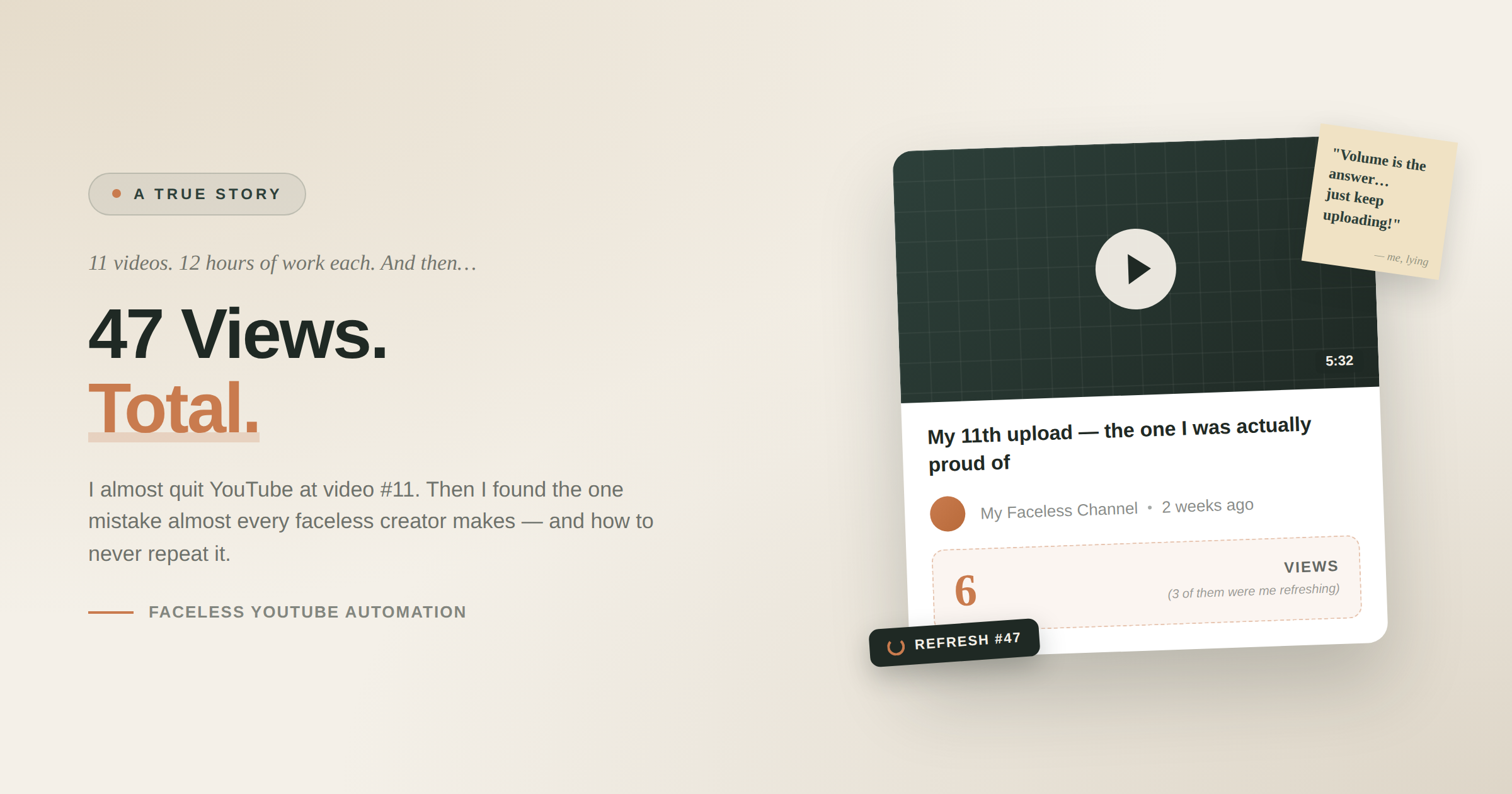
The first video I ever uploaded to my faceless YouTube channel got 6 views in the first week.
Three of them were me, refreshing the page like an idiot to see if anything had changed.
I remember sitting at my kitchen table at 11 p.m. staring at that view counter, trying to convince myself it was fine. “It’s the algorithm. New channels start slow. Just keep uploading. Volume is the answer.” That’s what every YouTube guru on the planet had told me, so that’s what I did.
Eleven uploads later, my channel had a grand total of 47 views.
Forty-seven. Across eleven videos. Some of them I had spent twelve hours making. One of them I was secretly really proud of — a beautifully scripted piece on a topic I genuinely cared about. It got 2 views in two weeks, and I’m pretty sure one of them was my mom.
That was the moment I almost quit.
But before I did, I forced myself to do something I should have done before I uploaded a single video: I actually looked at why my videos weren’t getting views. And what I found completely changed the way I think about YouTube — not just as a creator, but as someone trying to understand how the platform actually works.
This is the story of what I learned. And if you’re in the same place I was — uploading into the void, wondering if the platform is rigged or if you’re just bad — read this carefully. Because I promise you, you’re not bad. You’re just doing the one thing nobody warns you not to do.
The Lie I’d Been Telling Myself
Here’s the lie I was buying into, and I bet you’re buying into it too:
“If I make good content, people will find it.”
It sounds reasonable. It sounds fair. It’s how everyone wishes the world worked.
It’s also completely, dangerously wrong.
YouTube doesn’t reward “good content.” YouTube rewards content that people are already searching for and clicking on. Those are two entirely different things. The first is about quality. The second is about demand.
I had been making videos about topics that I found interesting. Topics that I thought were valuable. Topics that I assumed people would want to watch. And every single one of those assumptions was wrong.
It’s like opening a restaurant in the middle of the desert because you make really good pasta. The pasta might be incredible. Nobody is driving through the desert to find out.
The breakthrough wasn’t about making better videos. It was about making videos people were already looking for.
The Night I Found a $0 Tool That Changed Everything
Around video number eight, I was deep in a rabbit hole at 2 a.m., reading forum posts from creators who had grown channels from zero to 100K subscribers in under a year.
One comment stopped me cold. It was from a guy who said his entire channel strategy was built on a single insight: he never came up with video ideas himself. He let his audience tell him what they wanted.
He listed three free tools he used. Three. Not a paid course. Not a $97 mastermind. Three free tools and a method that took maybe an hour to learn.
I closed my laptop that night feeling something I hadn’t felt in months: actual hope.
The next morning I tried his method on the niche I’d been struggling in. Within 40 minutes I had a list of 23 video topics that I could prove people were actively searching for. Not guesses. Not vibes. Actual search data showing real humans typing these exact things into YouTube.
My twelfth upload — the first one I made using this method — got 1,800 views in a week.
I want to be honest with you: 1,800 views isn’t viral. It’s not life-changing. But coming from 6 views? It felt like winning the lottery. More importantly, it was proof. Proof that the problem hadn’t been me. The problem had been that I was making videos for an audience that didn’t exist, instead of an audience that was right there, waiting for someone to answer their questions.
What I Was Doing Wrong (And What Almost Every Beginner Does)
When I look back at those first 11 dead videos, I can pinpoint exactly what killed them. And almost every beginner I’ve talked to since has made the same mistakes.
I was guessing instead of researching. I’d think “this sounds like a good video” and that was the entire validation process. I never once checked whether anyone was actually searching for the topic before I spent 10 hours producing it.
I was choosing topics that were too broad. “Personal finance tips” isn’t a video idea. It’s a category. It’s like saying you want to write a book about “stuff.” Specific topics get views. Broad topics get buried.
I was making videos for people who already knew the answer. A lot of my ideas were intermediate or advanced. The biggest audiences on YouTube are people at the very beginning of a learning curve. They’re the ones searching the most, watching the most, and subscribing the most.
I was ignoring what people were already clicking on. I never once looked at the top-performing videos in my niche to see what was actually working. I just assumed I knew better. I didn’t.
I was confusing my interests with audience demand. I made the videos I wanted to make. Nobody had asked for them. And the platform reflected that back to me, mercilessly, in the form of a 6-view counter.
If any of this sounds like you — please don’t take it as discouragement. Take it as relief. Because every single one of these mistakes is fixable in an afternoon. I just didn’t know what I didn’t know.
The Shift That Changed Everything
The real shift wasn’t a tactic. It was a mental flip.
I stopped asking “What video do I want to make?”
I started asking “What video are people already trying to find?”
That’s it. That’s the whole reframe. It sounds almost too simple. But the moment I made it, everything else fell into place — the topics, the titles, the thumbnails, even the scripts. Because when you know what someone is searching for, you also know what they’re hoping to find. And when you give them exactly that, the algorithm rewards you for it.
A friend once told me that the best businesses don’t sell what they want to sell — they sell what people are already trying to buy. YouTube channels work the same way. The best channels don’t create what they want to create. They create what people are already trying to find.
What I Actually Did (And What You Can Steal)
Here’s what I started doing after that 2 a.m. forum dive. I’m not going to give you the full breakdown here — that’s what the free guide is for — but I’ll share enough that you can see the shape of it.
I started spending 30 minutes before every video, doing what I now call “demand research.” Not how-to-go-viral stuff. Just looking at what real humans are typing into the platform in my niche, what the top-performing videos on those topics looked like, and whether smaller channels were getting traction with them or only the giants were.
I started reading Reddit and Quora threads in my niche — not to find ideas, but to find exact phrases people use when describing their problems. The phrases they typed became the foundation of my titles and scripts. Suddenly my videos sounded like they were reading viewers’ minds — because, in a way, they were.
I started checking trending topics weekly using a completely free tool that almost nobody outside the marketing world knows about. When something started climbing, I’d be one of the first to make a video on it. Not the last. Being early to a trend is worth more than being clever.
I built a simple shortlist filter: every idea had to pass four checks before I produced it. If it failed even one, it went in the trash. The filter took 5 minutes per idea. It saved me from spending 10 hours on videos that would have gotten 6 views.
That’s the system. It’s not glamorous. It’s not “one weird trick the algorithm doesn’t want you to know.” It’s just doing what 95% of beginners refuse to do: research demand before producing supply.
The Free Guide That Walks You Through Every Step
Look — I could have written this entire process out in this blog post. But honestly, it would turn into a 7,000-word manual that you’d skim, save, and never actually use.
So I did the next best thing. I packaged the full system into a clean, no-fluff PDF you can download in 10 seconds. It includes:
The exact two-prompt method I use to generate weeks of validated video ideas in a single afternoon — including the specific wording that makes the difference between a useful list and a generic one.
The 4-point shortlist filter that tells you whether an idea is worth producing before you waste hours on it.
The completely free tool I use weekly to spot rising trends and ride them up.
A bonus niche shortlist showing the 5 niches consistently producing real income for faceless creators — and the realistic earning range for each.
And the 7-day launch checklist to take you from zero to first video uploaded by next Sunday.
It’s free. No credit card. No upsell trap. Just the resource I wish someone had handed me before I uploaded those 11 dead videos.
→ Download the Free Faceless YouTube Starter Guide
If you grab it tonight and follow it this weekend, you’ll have a list of validated video ideas — and your first script — before Monday morning.
Or — If You’re Ready to Skip the Trial-and-Error Phase Entirely
I want to be straight about something.
The free guide will absolutely fix the “I don’t know what to make videos about” problem. It’s the foundation. It’s everything I would have killed for at video number 8.
But there’s a deeper layer that takes a channel from “my videos finally get views” to “my channel pays me every month.” And it’s not just better ideas.
It’s the content funnel — the deliberate system where every video on your channel has a role in turning random viewers into loyal subscribers, and loyal subscribers into actual income. It’s batch production so you can produce 20 videos in a single weekend instead of grinding out one a week. It’s the thumbnail and title formulas that determine whether a great topic gets 500 views or 50,000. And it’s monetization beyond AdSense — the revenue streams that turn a channel into a real business.
That entire system — all 10 chapters, with worksheets, swipe files, and the full automation playbook — is in the complete Faceless YouTube Automation Framework.
If you’re tired of being a beginner and you want to skip months of figuring it out the hard way, this is the shortcut.
→ Get the Full Faceless YouTube Automation Guide
Looking Back
Sometimes I open that old folder of dead videos. The 11 uploads with their pitiful view counts. The thumbnails I spent hours on. The scripts I was so proud of.
I don’t feel embarrassed anymore. I feel grateful.
Because those 11 videos taught me something no course could have: that wanting to succeed isn’t enough. You have to actually understand the game you’re playing. And once you do, everything that felt impossible suddenly becomes a series of small, doable steps.
If you’re sitting where I was — staring at a dead view counter, wondering if it’s the algorithm or you — it’s neither. It’s just one missing piece. And it’s a piece you can put in place this weekend.
→ Free Starter Guide | Full Framework
The next video you upload could be the one that changes everything. But only if you make the right one.