YouTube Automation: My AI Didn’t Save Me
Everyone online seemed to have the same answer. Need content? Use AI. Need video ideas? Use AI. Need scripts? Use AI. Need thumbnails? Use AI. At one point, it felt like AI was being sold as a magic button for success.
So I did what many beginners do. I downloaded the tools. I watched the tutorials. I generated ideas. I created scripts. I started building content.
And yet, something wasn’t working. The tools were helping — but they weren’t solving the actual problem. That’s when I learned a lesson that completely changed the way I think about YouTube. AI wasn’t the thing I was missing.
The Dangerous Assumption Most Beginners Make
When people discover YouTube automation, they often think the hardest part is creating content. That’s why AI feels so exciting. Suddenly you can create scripts faster, generate endless ideas, and produce videos in a fraction of the time.
But here’s the catch. Speed only helps when you’re moving in the right direction. If you’re moving in the wrong direction, AI simply helps you get there faster.
And that’s exactly what happened to me. I had tools. I had ideas. I had content. What I didn’t have was a system.
The Decision That Changed Everything
The breakthrough wasn’t a new AI tool. It wasn’t a better prompt. It wasn’t a more advanced workflow. It was one simple decision: I stopped asking how to make videos, and started asking what kind of channel I was building.
That question changed everything. Because successful channels aren’t collections of random videos. They’re systems. Every video has a purpose. Every topic fits a bigger strategy. Every piece of content moves the audience somewhere. Without that structure, even good content struggles.
Why AI Can’t Fix a Bad Niche
One of the biggest mistakes beginners make is choosing a niche they hope will work, then using AI to create content inside that niche. The problem? If nobody cares about the topic, better scripts won’t save it. Better thumbnails won’t save it. More videos won’t save it.
AI can improve execution. But it can’t create demand. That’s why niche selection matters more than most people realize. The right niche makes growth easier. The wrong niche makes growth feel impossible.
Why More Content Isn’t Always Better
Many creators assume they need more videos. More uploads. More consistency. More effort. But volume isn’t the same thing as strategy.
You can upload 100 videos and still have no clear direction. Or you can upload 20 videos that all support the same goal. The difference isn’t effort — it’s structure. That’s why some channels grow surprisingly fast while others stay stuck for years.
The Real Power of AI
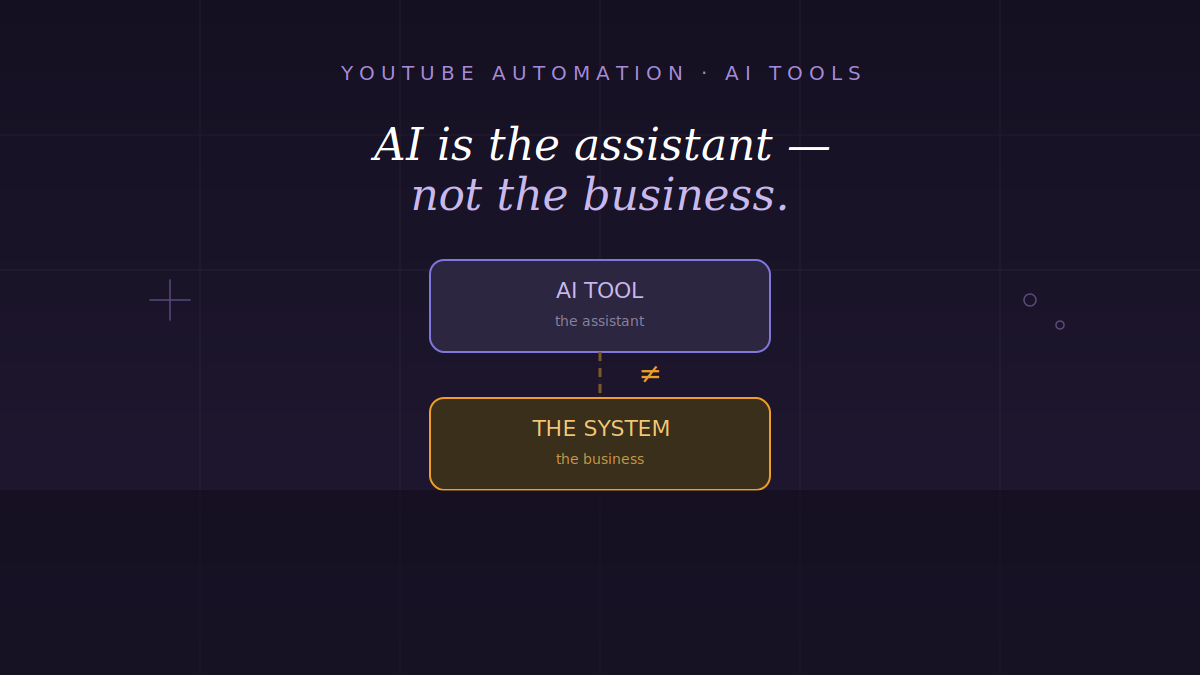
This might sound strange coming from someone who believes in YouTube automation. But AI is not the business. AI is the assistant.
AI helps you write. AI helps you research. AI helps you produce. But the system determines whether any of that work matters — the niche, the content plan, the audience journey, the content funnel. Those decisions come first.
What Successful Faceless Channels Do Differently
The channels that scale don’t start with tools. They start with clarity. They know:
- Who they’re creating for
- What problems they’re solving
- Which topics attract attention
- Which videos build trust
- How viewers move through their content
Only then do they use AI to speed everything up. AI becomes an accelerator — not a replacement for strategy.
My AI didn’t save me. Because it was never supposed to. The tool wasn’t the missing piece. The system was.
Once I understood that, everything became simpler. Content ideas made more sense. Videos became easier to plan. Growth became easier to predict. And for the first time, I stopped chasing tools and started building something that could actually last.
Free Starter Guide
If you want to build a faceless YouTube channel without showing your face, recording videos, or spending hours editing — this free guide reveals the first 3 steps successful faceless creators get right before they upload their first video.