The Psychology Gap Destroying Most Faceless Funnels
Most creators think they have a traffic problem.
So they post more.
More pins. More Reels. More TikToks. More hooks. More content calendars. More trends.
But quietly, underneath all that activity, something else is happening:
People are watching… and leaving.
No email signup.
No trust.
No purchase.
No real movement.
And the reason is usually not the content itself.
It’s the psychology gap inside the funnel.
What Most Creators Get Wrong About Funnels
When people hear the word “funnel,” they usually imagine:
- landing pages,
- email sequences,
- sales pages,
- automation tools,
- checkout links.
But a funnel is not a collection of pages.
A funnel is a psychological journey.
It’s the invisible process happening inside someone’s mind between:
“This caught my attention”
and
“I trust this enough to take action.”
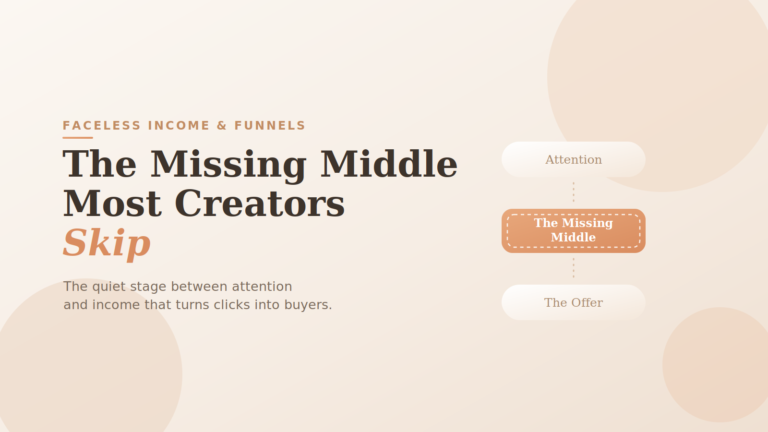
Most faceless creators skip that middle section entirely.
They create content that gets curiosity… then immediately push an offer.
And the human brain almost never works that fast.
Attention Is Not Trust
This is the mistake destroying most faceless funnels.
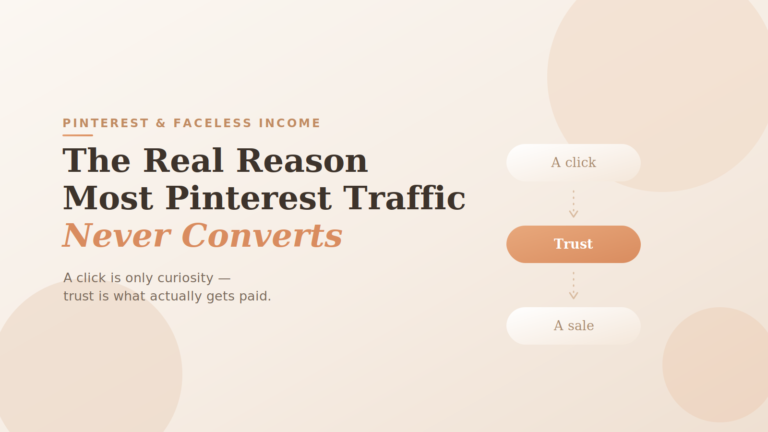
A viral pin does not mean someone trusts you.
A Reel view does not mean someone is emotionally ready.
A click does not mean belief.
Attention is only the first micro-step.
After attention comes evaluation.
People silently ask themselves:
- Who is this person?
- Is this real?
- Does this actually make sense?
- Is this another fake “make money online” promise?
- Why should I listen to them?
- Is this safe?
- Is this relevant to me?
Most creators never answer these questions.
They assume:
“If people are interested, they’ll buy.”
But psychologically, interest and readiness are completely different states.
The Real Job of a Funnel
A good funnel does not pressure people.
It guides them.
It reduces confusion.
It creates clarity.
It builds emotional safety.
It removes resistance step-by-step.
That’s why the best faceless funnels feel calm and logical instead of aggressive.
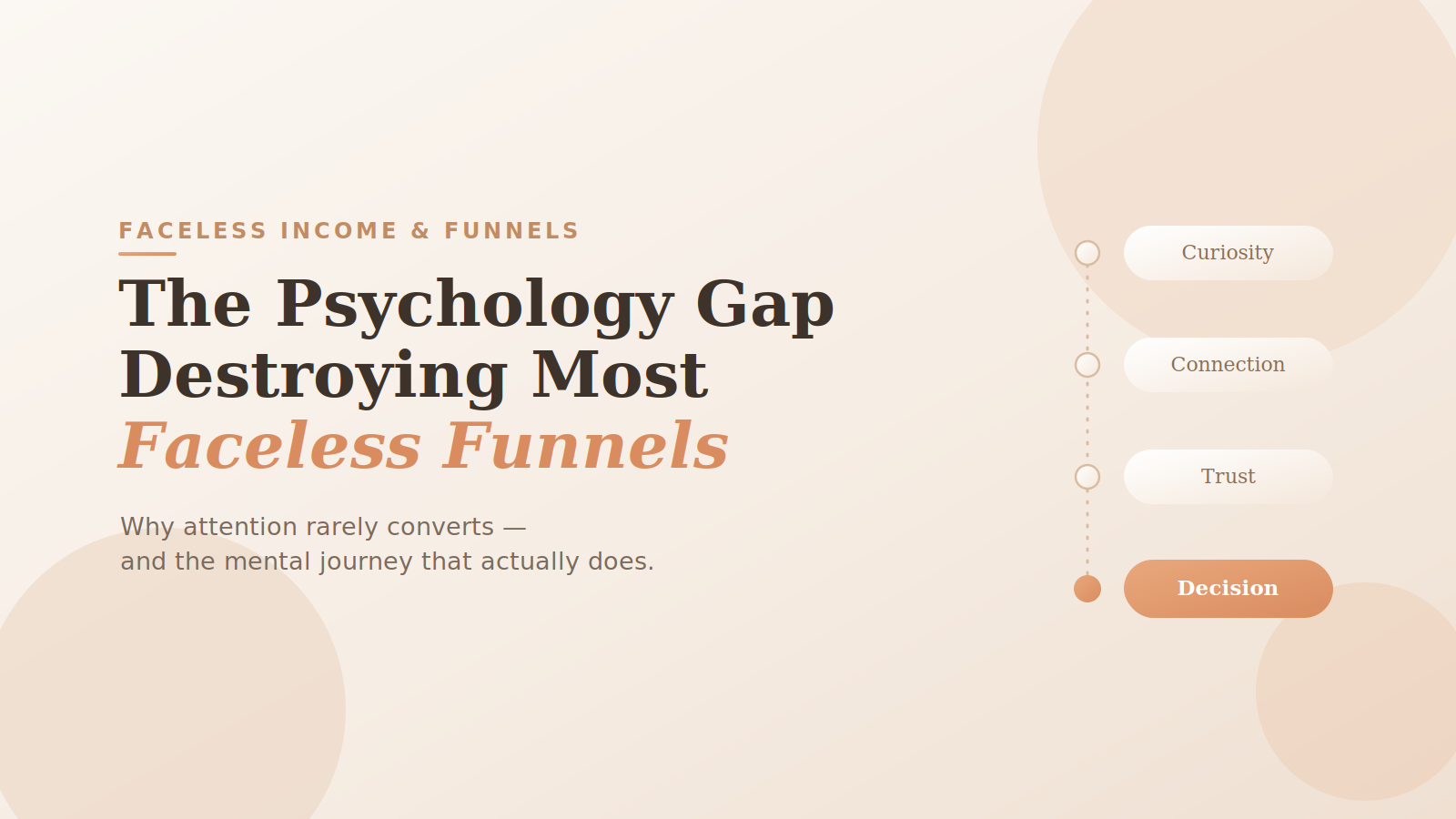
They move people through stages:
1. Curiosity
Something interrupts the scroll.
A sentence.
A perspective.
A problem people recognise in themselves.
This is where Pinterest content, hooks, blog headlines, and Reels matter.
But curiosity alone is fragile.
Without the next stage, attention disappears quickly.
2. Psychological Connection
This is the stage most creators ignore.
People need to feel:
- understood,
- seen,
- emotionally safe,
- intellectually convinced.
This is where storytelling, education, and positioning become powerful.
Not because they “entertain.”
Because they reduce uncertainty.
The brain is constantly scanning for risk.
Especially in faceless business niches where trust is naturally lower.
A good funnel lowers that psychological friction.
3. Trust
Trust happens when someone starts thinking:
“This person actually understands the problem.”
Not:
“This person has a nice Canva template.”
Trust is built through:
- clarity,
- consistency,
- specificity,
- calm explanations,
- logical systems,
- emotional resonance.
This is why educational blogs often outperform direct sales pages in faceless funnels.
They create cognitive certainty.
4. Decision
Only now does someone become ready to act.
And even then, the decision usually feels emotional first and logical second.
People buy when the internal tension becomes stronger than the fear of action.
That’s why the best funnels don’t scream:
“BUY NOW.”
Instead, they quietly create the feeling:
“This finally makes sense.”
Why Most Faceless Funnels Feel Broken
Most creators build funnels backwards.
They focus heavily on:
- products,
- aesthetics,
- automation,
- platforms,
- templates,
- viral content.
But they ignore emotional movement.
So the funnel becomes:
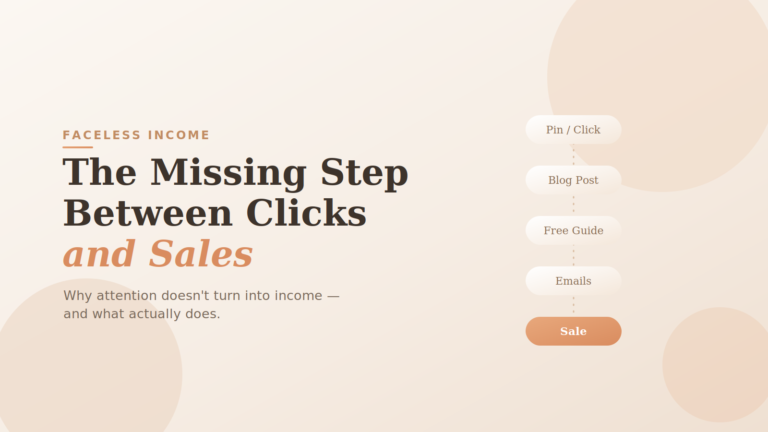
Attention → Offer
instead of:
Attention → Understanding → Trust → Readiness → Offer
That missing middle is the psychology gap.
And it silently destroys conversions.
Virality Without Psychology Creates Empty Traffic
This is why some creators get:
- thousands of views,
- huge impressions,
- viral spikes,
- lots of saves,
- high reach…
…but almost no income.
Because attention without guided psychology is unstable.
People consume the content… then mentally move on.
A strong faceless funnel creates continuity.
It keeps guiding the brain forward.
The Best Funnels Feel Like Clarity
The highest-converting faceless systems rarely feel “salesy.”
They feel clarifying.
The audience starts understanding:
- why they’re stuck,
- what’s missing,
- what actually matters,
- why random content isn’t enough,
- why structure changes everything.
That emotional clarity is what creates action.
Not pressure.
Final Thought
Most creators do not need:
- more platforms,
- more content,
- more complicated automations.
They need a better psychological path.
Because a funnel is not just a marketing system.
It’s the journey from:
confusion
to
certainty.
And the creators who understand that are usually the ones who eventually turn attention into real faceless income.
Want the full faceless funnel structure explained step-by-step?
Download the free Faceless Income Starter Blueprint and see how attention turns into trust — and trust turns into income.