How to Choose a Profitable Faceless Niche as a Beginner
Choosing a niche can feel like the most permanent decision you will ever make.
It is not.
Your first niche does not need to define the rest of your life. It only needs to give your business enough direction to attract the right audience, publish useful content, and test a realistic offer.
A profitable faceless niche sits at the intersection of four things:
- A specific audience
- A recurring problem or goal
- Topics you can create content about consistently
- Products, services, or resources that audience members already value
The best niche is not necessarily the one with the highest theoretical income.
It is the one you can understand, serve, and build around long enough to gather real evidence.
This guide will show you how to choose a faceless business niche without relying on guesswork, temporary trends, or unrealistic income claims.
Affiliate disclosure: This article contains affiliate links. If you sign up or make a purchase through one of my links, I may earn a commission at no additional cost to you. I only recommend resources that I believe can genuinely help beginner online business owners.
What Is a Faceless Business Niche?
A niche is the specific part of a larger market your business serves.
For example:
- Health is a broad market.
- Home workouts is a category.
- Low-impact home workouts for women over 40 is a more specific niche.
Likewise:
- Online business is a broad market.
- Digital products is a category.
- Simple digital products for first-time faceless creators is a clearer niche.
A faceless niche should be specific enough that you can identify:
- Who the content is for
- What they want
- What prevents them from achieving it
- What topics they search for
- What products or services could help
You do not need to serve everybody who might be interested in the general topic.
A clear niche helps the right person recognize:
“This content is for someone like me.”
If you are still deciding which business model to use, explore these 12 faceless business ideas for beginners first.
What Makes a Niche Profitable?
A profitable niche is not simply a popular topic.
Popularity can bring traffic, but traffic alone does not create a business.
A niche needs a realistic connection between the audience’s needs and something valuable you can offer or recommend.
Look for five signals.
1. People actively want a result
The audience should be trying to:
- Solve a problem
- Learn a skill
- Save time
- Reduce stress
- Make a decision
- Improve a situation
- Complete a project
A niche built around a clear result is easier to understand than a niche built around general inspiration.
2. The problem appears repeatedly
One person asking a question does not necessarily indicate a market.
Look for recurring questions across:
- Search engines
- Online communities
- Product reviews
- Comments
- Forums
- Competitor content
- Marketplace searches
Repeated questions suggest an ongoing need for content or products.
3. The audience already purchases solutions
Search for products, tools, services, courses, templates, books, and subscriptions connected to the niche.
Existing products do not automatically mean the niche is too competitive. They can be evidence that people spend money to solve the problem.
4. You can create multiple useful content topics
A niche is difficult to sustain if you can think of only three articles.
A stronger niche gives you topics across different stages:
- Beginner questions
- How-to tutorials
- Mistakes
- Product comparisons
- Checklists
- Examples
- Troubleshooting
- Next-step content
5. The niche supports at least one monetization path
A faceless niche might earn through:
- Affiliate marketing
- Digital products
- Online courses
- Templates
- Services
- Memberships
- Sponsorships
- Advertising
- Paid newsletters
You do not need all of them.
One primary and one secondary monetization path are enough to begin.
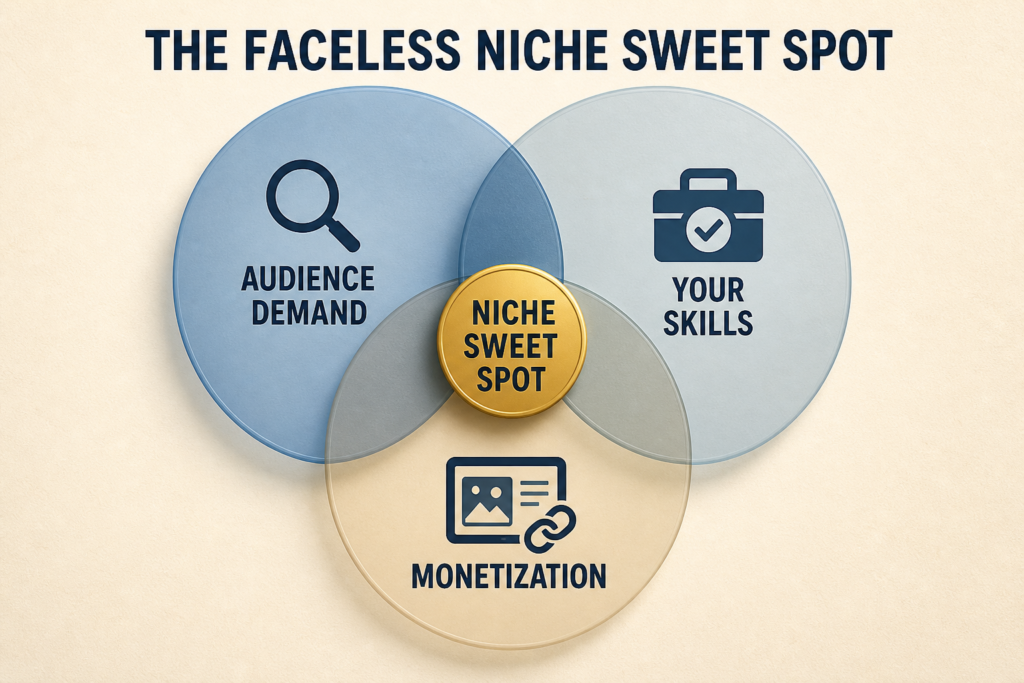
The Faceless Niche Sweet Spot
Your niche should balance three main factors:
Audience demand
Are people already searching for information, asking questions, and purchasing solutions?
Your ability to create value
Can you research, explain, organize, design, curate, teach, or demonstrate something useful?
You do not have to be the world’s leading expert. But you should be willing to learn, verify information, and create better resources over time.
Monetization potential
Can you connect the audience’s problem with a relevant product, service, or recommendation?
The ideal niche sits where all three overlap.
Avoid choosing only by passion. Interest without demand may remain a hobby.
Also avoid choosing only by money. A theoretically profitable topic is not useful if you dislike the work or cannot create credible content about it.
Step 1: Start With an Audience, Not a Logo
Before thinking about colors, domains, or social-media usernames, define who you want to help.
Compare these two descriptions:
People who want to make money online.
And:
Beginners who want to build their first online income stream without showing their face.
The second audience is easier to understand.
Ask:
- What stage of life or business are they in?
- What are they trying to achieve?
- What have they already tried?
- What makes the process difficult?
- What would make the next step easier?
- What language do they use to describe the problem?
Your audience does not need to be defined by age or gender unless those details genuinely affect the solution.
A niche can also be defined by:
- Experience level
- Goal
- Limitation
- Profession
- Lifestyle
- Interest
- Preferred method
For example:
- Digital products for complete beginners
- Meal planning for busy shift workers
- Pinterest marketing for introverted creators
- Budget travel planning for large families
- Home organization for small apartments
Step 2: Choose a Broad Market
Start with one market you are interested in exploring.
Common evergreen markets include:
- Business and careers
- Health and wellness
- Personal finance education
- Relationships
- Home and lifestyle
- Hobbies
- Education
- Travel
- Beauty and fashion
- Technology
- Parenting
- Productivity
Do not stop at the broad market.
“Health,” “travel,” or “business” is too general to guide your content and offers.
Use the broad market only as the starting point.
Step 3: Narrow the Market With Four Questions
Use these four filters to create a more specific niche.
Who is it for?
Examples:
- Beginners
- College students
- Freelancers
- New parents
- Remote workers
- Introverts
- Small-business owners
What do they want?
Examples:
- Start a side business
- Organize their home
- Learn a software tool
- Plan affordable trips
- Create digital products
- Improve productivity
What is stopping them?
Examples:
- Limited time
- Small budget
- No technical skills
- No audience
- Too much conflicting information
- Discomfort appearing on camera
What method will you focus on?
Examples:
- Blogging
- Templates
- Email marketing
- Meal preparation
- Screen-recorded tutorials
- Printable planners
You can combine the answers into a niche statement:
I help [audience] achieve [result] despite [obstacle] using [method].
For BehindTheCEO, that might be:
I help beginners build a simple online income system without becoming the public face of the brand, using strategic content, digital products, affiliate marketing, and email funnels.
Step 4: Create Three Possible Niche Statements
Do not research 30 unrelated niche ideas at the same time.
Write three possibilities.
For example:
- Faceless affiliate blogging for beginners
- Digital-product creation for introverted creators
- Pinterest traffic for anonymous online brands
Keep each option specific enough to test, but not so narrow that you cannot create content.
Instead of:
Business tips for left-handed mothers aged 32 to 34 who work remotely
Try:
Simple online-business systems for busy mothers who want to work behind the scenes
You can narrow the content further after seeing which questions attract attention.
Step 5: Validate Search Demand
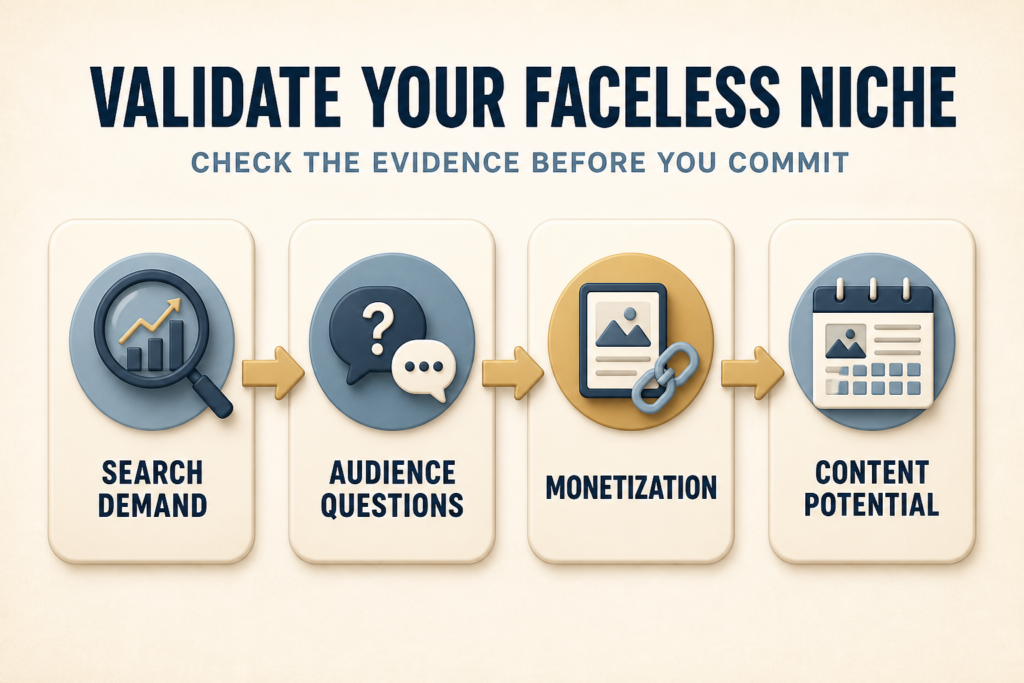
Search demand helps you determine whether people actively look for information about the niche.
You do not need expensive keyword software for your first validation.
Use Google autocomplete
Enter the beginning of a relevant question.
For example:
- How to start a faceless…
- Best tools for digital…
- Can I make money with…
- How to create a Pinterest…
- Why is my email…
Record the suggestions that match your intended audience.
Autocomplete can help reveal common phrasing, but it should not be your only source of evidence.
Review People Also Ask
Search a central niche question and examine the related questions Google displays.
Look for recurring themes and beginner concerns.
Use Google Trends
Google Trends helps you compare relative search interest over time and across locations.
Compare several related terms, such as:
- Digital products
- Affiliate marketing
- Print on demand
- Online course
- Email newsletter
Use a longer timeframe, such as the past five years, to identify whether interest is:
- Stable
- Seasonal
- Gradually growing
- Declining
- Driven by a short-lived spike
Google explains that Trends data is normalized on a scale from 0 to 100. It shows relative interest, not the exact number of searches.
Use it as one research signal—not proof that a niche will be profitable.
Check related searches
Review the top and rising related searches inside Google Trends.
These can reveal smaller problems and content angles within the broader niche.
Search Pinterest
If Pinterest will be one of your traffic sources, search the topic there.
Look at:
- Suggested keywords
- Repeated content themes
- Types of pins receiving visibility
- Seasonal patterns
- Questions not answered clearly
- Whether the niche is naturally visual or instructional
Pinterest can be especially useful for planning, education, tutorials, ideas, and evergreen inspiration.
Step 6: Study Real Audience Questions
Keyword tools show what people search for. Communities often show why the problem matters.
Explore relevant:
- Reddit communities
- Facebook groups
- Forums
- YouTube comments
- Product reviews
- Course reviews
- App reviews
- Public question-and-answer sites
Do not enter communities only to promote your content.
Use them to listen.
Create a simple research document with four columns:
| Audience statement | Problem | Desired result | Possible content |
|---|---|---|---|
| “I don’t know which niche to choose.” | Too many options | Clear direction | Niche-selection checklist |
| “I hate being on camera.” | Discomfort with visibility | Faceless content method | Faceless content-format guide |
| “The tools are too expensive.” | High startup costs | Affordable system | Free funnel tutorial |
| “I don’t know what to sell.” | Unclear offer | First product idea | Beginner digital-product guide |
Use the audience’s language as inspiration for topics, not as text to copy.
Step 7: Check the Monetization Options
A niche is more commercially useful when the audience already invests in solving its problems.
Search for:
- Relevant software
- Affiliate programs
- Books
- Templates
- Courses
- Memberships
- Physical products
- Services
- Events
- Paid newsletters
Then ask:
- Are the products genuinely relevant?
- Could I create useful tutorials or reviews?
- Is there room for a small original product?
- Could a service solve the problem faster?
- Would the audience reasonably pay for convenience or clarity?
Affiliate marketing
Affiliate marketing works well when the niche uses identifiable products or tools.
Examples include:
- Software
- Web hosting
- Online education
- Business tools
- Travel products
- Hobby equipment
- Home products
The product should fit the content naturally.
Digital products
Digital products work when information, organization, or a reusable system can help the audience.
Examples include:
- Templates
- Planners
- Checklists
- Workbooks
- Spreadsheets
- Swipe files
- Mini-courses
Services
Services can work when the audience needs implementation, customization, or ongoing help.
Examples include:
- Pinterest management
- Blog formatting
- Research
- Design
- Editing
- Email setup
- Website updates
Advertising
Advertising generally depends on traffic volume. It is better treated as a future option than the only monetization plan for a new blog.
Step 8: Evaluate the Competition
Competition does not automatically make a niche bad.
A complete absence of competition may mean there is little demand.
Instead of asking whether competition exists, ask:
- Can I serve a clearer audience?
- Can I explain the topic more simply?
- Can I create better examples?
- Can I focus on beginners?
- Can I combine two relevant angles?
- Can I update outdated information?
- Can I create a more useful resource?
For example, “affiliate marketing” is broad and competitive.
A clearer angle might be:
Affiliate blogging for faceless-business beginners using free or low-cost tools.
You are not trying to invent a topic nobody has considered. You are trying to create a clear, useful position within an existing market.
Step 9: Check Whether the Niche Works Faceless
Some niches are naturally easier to build without personal visibility.
A faceless-friendly niche should support content such as:
- Written articles
- Branded graphics
- Diagrams
- Product photography
- Screen recordings
- Voiceovers
- Slides
- Tutorials
- Checklists
- Templates
- Email content
Ask:
- Can I demonstrate the result without personal photos?
- Can I build trust with examples, research, and clear explanations?
- Can I create original visual content?
- Can I publish consistently without relying on my private life?
- Does the audience expect personal access or live interaction?
A niche can still involve services or customer support. It simply should not require your face to be the primary marketing asset if that is not the business you want.
Step 10: Test Your Content Potential
Before choosing the niche, write 30 possible content titles.
Divide them into categories.
Beginner content
- What is…
- How to start…
- Beginner mistakes…
- What do you need…
- How much does it cost…
Problem-solving content
- Why your…
- How to fix…
- What to do when…
- How to avoid…
- The simplest way to…
Commercial content
- Best tools for…
- Product review
- Product comparison
- Is this tool worth it?
- Free versus paid options
Conversion content
- Checklist
- Template
- Tutorial
- Case study
- Step-by-step system
If you cannot create 30 useful titles, the niche may be too narrow—or you may need more research.
If you can create hundreds without a clear direction, it may still be too broad.
Step 11: Score Your Three Niche Options
Score each possible niche from one to five.
| Criterion | Score |
| Audience problem is clear | /5 |
| People search for the topic | /5 |
| Audience purchases solutions | /5 |
| At least one monetization method fits | /5 |
| I can create 30 useful topics | /5 |
| The niche works without showing my face | /5 |
| I am willing to research it consistently | /5 |
| I can explain my angle clearly | /5 |
Maximum score: 40.
The score is not a scientific prediction. It forces you to compare options using the same criteria instead of choosing based on excitement alone.
If you need a structured way to define your niche, audience, content direction, and monetization path, use the Faceless Income Starter Blueprint.
Get the Faceless Income Starter Blueprint →
Examples of Clearer Faceless Niches
Here are examples of broad ideas turned into more specific directions.
| Broad idea | Clearer faceless niche |
| Online business | Faceless online business systems for beginners |
| Productivity | Simple productivity systems for remote workers |
| Travel | Budget European travel planning for families |
| Home organization | Small-apartment organization for renters |
| Digital products | Beginner templates for service providers |
| Personal finance | Simple budgeting education for freelancers |
| Fitness | Low-impact home workouts for women over 40 |
| Food | Quick meal-prep systems for shift workers |
| Pinterest traffic for faceless affiliate bloggers | |
| Technology | Beginner software tutorials for solopreneurs |
The narrower version does not prevent future expansion.
It simply gives your first content and offers a clearer direction.
Niche Ideas to Approach Carefully
Some topics carry higher trust, accuracy, or legal requirements.
Examples include:
- Medical advice
- Mental-health treatment
- Legal advice
- Investing
- Tax advice
- Child safety
- Supplements
- Credit repair
These can attract significant demand, but inaccurate information can cause real harm.
If you do not have appropriate expertise, choose an educational angle that stays within your competence or select a lower-risk niche.
Never use a faceless format to avoid accountability for high-stakes advice.
Common Niche-Selection Mistakes
Choosing only by estimated income
Revenue screenshots do not show the creator’s experience, audience, expenses, time, or previous failures.
Choose based on evidence you can verify.
Following a short-lived trend
A trend can provide temporary attention but may not support a long-term business.
Look for recurring problems and stable interest.
Choosing a niche that is too broad
Broad niches make it harder to know what to publish and why a reader should follow you.
Choosing a niche that is too narrow
If only a tiny group experiences the problem once, the niche may not provide enough content or product potential.
Copying another creator’s niche exactly
Use competitors to understand the market, not to reproduce their positioning.
Rebranding every two weeks
Constantly changing direction prevents you from collecting meaningful data.
Choose a reasonable niche and test it consistently before deciding it failed.
How Long Should You Test a Niche?
Give the niche enough time and content to produce evidence.
A practical first test might include:
- 10 to 20 useful articles
- One lead magnet
- One email welcome sequence
- One relevant offer
- Consistent promotion through one traffic source
- Several months of search and audience data
Do not expect a new SEO article to prove the entire niche within a few days.
Track:
- Search impressions
- Clicks
- Email subscriptions
- Questions readers ask
- Affiliate clicks
- Product interest
- Content topics receiving the most attention
Then refine the niche based on actual behavior.
Build the First Version of Your Niche Funnel
Once you choose the niche, create a simple path:
Content → Email list → Relevant offer
For example:
- Publish a beginner guide targeting a specific question.
- Offer a useful checklist related to the article.
- Collect the reader’s email address.
- Deliver the checklist.
- Send a short welcome sequence.
- Introduce a relevant product or resource.
You can build this basic funnel with Systeme.io.
Create a free Systeme.io account →
For the complete tutorial, read How to Build Your First Faceless Business Funnel for Free
If you still need the broader setup process, read How to Start a Faceless Online Business for Beginners
A Simple Seven-Day Niche Validation Plan
Day 1: Select three ideas
Write one clear niche statement for each.
Day 2: Research search questions
Use Google, Google Trends, and Pinterest to identify recurring topics.
Day 3: Study audience conversations
Record real problems, desired results, and objections.
Day 4: Check existing offers
Review relevant affiliate products, digital products, services, and competitors.
Day 5: Create 30 content ideas
Group them into beginner, problem-solving, commercial, and conversion content.
Day 6: Score each niche
Use the 40-point scorecard.
Day 7: Choose one direction
Commit to testing it with content and one simple funnel.
You do not need perfect certainty.
You need enough evidence to make a reasonable decision and enough consistency to learn from it.
Your Niche Is a Starting Point
Choosing a niche is not a lifetime contract.
It is a strategic starting point that helps you:
- Understand the audience
- Create focused content
- Build relevant offers
- Choose suitable affiliate products
- Develop recognizable expertise
- Measure what works
Start specific enough to be useful. Expand only when your audience and data give you a reason.
If you want a clearer process for choosing your niche and turning it into a content and income plan, use the Faceless Income Starter Blueprint.
Choose your direction with the Faceless Income Starter Blueprint →
Then build the first simple system behind it.
Start building your faceless business with Systeme.io →
Frequently Asked Questions
What is the most profitable faceless niche?
There is no universally most profitable niche. Results depend on audience demand, competition, content quality, trust, monetization, traffic, expenses, and execution. Choose a niche you can validate and serve consistently.
How narrow should my niche be?
Your niche should be specific enough to identify the audience, problem, and content direction, but broad enough to support at least 30 useful content topics and one realistic offer.
Can I change my niche later?
Yes. Your first niche is a testable business direction, not a permanent identity. Use audience response and performance data to refine it instead of changing it only because progress feels slow.
Should I choose a niche based on passion?
Interest matters because you need to create content consistently. However, passion alone does not prove demand or monetization. Balance your interests with audience needs and market evidence.
How do I know whether people will spend money in a niche?
Look for existing products, services, courses, software, books, templates, affiliate programs, and paid communities. Read reviews to understand what people value and what current solutions are missing.
Can a competitive niche still work?
Yes. Competition can confirm demand. Look for a clearer audience, better explanation, beginner angle, updated information, or more useful resources.
Do I need to be an expert?
You need enough knowledge to create accurate and responsible content. You can document your learning in lower-risk niches, but you should not provide medical, legal, financial, or other high-stakes advice beyond your qualifications.
How long should I test a niche?
Give it enough time to publish a useful body of content and collect meaningful traffic or audience data. For SEO-focused businesses, this usually requires patience rather than a test lasting only a few days.