How to Start a Faceless Online Business for Beginners
You do not need to become an influencer, share your personal life, or record yourself every day to build an online business.
A faceless online business allows you to create useful content, grow an audience, and promote products without making your identity the center of the brand.
You can build it using:
- Written blog content
- Pinterest graphics
- Screen recordings
- Voiceovers
- Email marketing
- Digital products
- Curated resources
- Branded social media content
But staying behind the scenes does not make the business automatic.
You still need a clear audience, a useful offer, consistent content, and a simple system that turns attention into email subscribers or customers.
This beginner-friendly guide will show you how to start a faceless online business step by step—without unnecessary tools or unrealistic income promises.
Affiliate disclosure: This article contains affiliate links. If you sign up or make a purchase through one of my links, I may earn a commission at no additional cost to you. I only recommend resources that I believe can genuinely help beginner online business owners.
What Is a Faceless Online Business?
A faceless online business is a brand that does not depend on the owner’s face, name, or personal lifestyle to attract customers.
Instead of making yourself the product, you build the brand around:
- A specific topic
- A recognizable visual identity
- Helpful content
- A clear audience problem
- A product, service, or recommendation
Your readers may know the name of your brand without knowing much about the person running it.
For example, a faceless brand could publish articles about productivity, create Pinterest content about home organization, sell digital templates, or run an email newsletter that recommends useful business tools.
The value comes from the information and resources—not from personal visibility.
Can a Faceless Business Still Build Trust?
Yes, but trust must come from the quality and consistency of your work.
A faceless brand can build credibility by:
- Publishing accurate and genuinely useful content
- Being clear about affiliate relationships
- Recommending relevant products
- Using consistent branding
- Showing examples and practical steps
- Updating outdated information
- Responding to reader questions
- Avoiding exaggerated income claims
You do not have to reveal everything about yourself. But your content should still feel like it was created by a thoughtful person who understands the reader’s problem.
Faceless should not mean generic, copied, or impersonal.
Step 1: Choose a Faceless Business Model
Before choosing a logo or opening social media accounts, decide how the business could eventually generate revenue.
You do not need every detail yet. You only need a realistic starting direction.
Here are several beginner-friendly options.
Affiliate marketing
Affiliate marketing allows you to earn a commission when someone purchases through your unique referral link.
You can promote relevant products through:
- SEO blog posts
- Tutorials
- Product comparisons
- Resource pages
- Email sequences
- Pinterest content
Affiliate marketing works best when you help readers choose or use a product—not when you place random links inside unrelated content.
For example, a blog teaching beginners how to build an online business could recommend a funnel and email platform such as Systeme.io.
Digital products
Digital products are files or resources customers can access online.
Examples include:
- Planners
- Checklists
- Templates
- Workbooks
- Swipe files
- Ebooks
- Mini-courses
- Notion templates
- Spreadsheet tools
You can create and sell these products without recording personal videos or showing your face.
Start with a small product that solves one clear problem rather than trying to create a large course immediately.
Niche blog
A niche blog publishes search-focused content for a specific audience.
The blog can earn through:
- Affiliate links
- Digital products
- Advertising
- Sponsored content
- Email promotions
SEO usually requires patience, but a useful article can continue bringing visitors long after it is published.
Faceless content brand
You can build a content-focused brand on platforms such as Pinterest, Instagram, TikTok, or YouTube without appearing on camera.
Possible formats include:
- Text-based videos
- Screen recordings
- Tutorials
- Slideshows
- Animations
- Stock footage with narration
- Branded carousels
Do not choose a platform only because faceless accounts appear popular there. Choose one that suits the type of content you can produce consistently.
Email newsletter
A niche newsletter can share advice, curated resources, product recommendations, or industry updates.
It can eventually earn through affiliate links, sponsorships, services, or your own products.
However, you still need a reliable source of traffic to attract subscribers.
Step 2: Choose a Specific Audience and Problem
Broad topics are difficult to turn into focused content.
“Online business” is a topic.
“Helping working mothers create their first digital product” is a clearer direction.
“Fitness” is a topic.
“Simple home workouts for women over 40” defines a more specific audience and need.
Ask yourself:
- Who do I want to help?
- What are they trying to achieve?
- What makes that goal difficult?
- What information or resource could make the next step easier?
- Are they already searching for solutions?
- Are there relevant products they purchase?
You do not need to find a niche that nobody has discovered. Existing competition can indicate that people are interested in the topic.
The goal is to find a clear angle—not an empty market.
Step 3: Validate the Niche Before Building Everything
You should not spend months creating a brand before checking whether the audience has real questions and purchasing options.
Start with basic research.
Search Google
Enter phrases related to your niche and examine:
- Suggested searches
- People Also Ask questions
- Articles already ranking
- Products mentioned in those articles
- Questions that existing content answers poorly
Check Pinterest
Search for your topic and review the suggestions Pinterest displays.
Look for recurring formats and questions, but do not copy other creators’ designs or content.
Review relevant communities
Explore forums, public groups, comments, reviews, and question-and-answer platforms.
Pay attention to the language people use when describing:
- Their frustrations
- Their desired results
- Tools they have tried
- Information they cannot find
- Reasons they hesitate to purchase
Identify monetization options
Check whether the niche supports relevant:
- Affiliate programs
- Digital products
- Services
- Advertising opportunities
- Subscriptions
- Sponsorships
A niche does not need all of these. One or two realistic monetization paths are enough to start.
Step 4: Create a Simple Brand Identity
A faceless business relies more heavily on recognizable visual and editorial consistency.
You do not need an expensive branding package.
Start with:
- A memorable brand name
- Two main colors and one accent color
- One heading font and one body font
- A simple logo or wordmark
- A consistent image style
- A clear writing voice
Your brand name should be easy to spell, remember, and use across platforms.
Before committing to a name, check:
- Domain availability
- Social-media availability
- Existing businesses with similar names
- Obvious trademark conflicts
- Whether the name still works if your business expands
Avoid delaying your launch while trying to create the perfect brand identity. Clear and consistent is more useful than elaborate.
Step 5: Decide Where Your Content Will Live
Your business needs a central platform you control.
For a content-led faceless business, this is usually a website or blog combined with an email list.
Social platforms can help people discover you, but algorithms and platform rules can change. Your website and email list give you more control over how people find and hear from your brand.
A simple beginner setup might include:
- A WordPress blog for SEO content
- Systeme.io for landing pages and email marketing
- Pinterest as the primary discovery platform
- Canva for branded graphics
You do not need accounts on every platform.
Choose:
- One platform you control
- One primary traffic source
- One email system
That is enough for your first stage.
Step 6: Create Content With a Purpose
Every piece of content should help the reader take a useful next step.
Content can serve different purposes.
Discovery content
This attracts people searching for beginner information.
Examples:
- How to start a faceless online business
- Best faceless-business ideas for beginners
- How to choose a faceless niche
- Can you do affiliate marketing without showing your face?
Problem-solving content
This addresses a specific difficulty.
Examples:
- How to create content when you do not want to be on camera
- How to build trust as a faceless brand
- How to choose your first digital product
- How to start an email list without an audience
Commercial content
This helps readers evaluate a tool or product.
Examples:
- Systeme.io review for beginners
- Best free funnel builders
- Systeme.io versus another email platform
- Best tools for a faceless online business
Conversion content
This directs the reader toward a product, lead magnet, or email funnel.
Examples:
- Tutorials using a product you recommend
- Case studies
- Resource pages
- Templates
- Step-by-step implementation guides
A healthy content strategy combines all four types instead of publishing only affiliate reviews or only general advice.
Step 7: Build Your Email List Early
Social followers and website visitors may never return.
An email list allows you to continue helping interested readers after their first visit.
Start with a simple lead magnet that solves one small problem.
Examples include:
- A faceless-niche checklist
- A beginner business roadmap
- A content-planning template
- A list of faceless content formats
- A digital-product idea workbook
- A tool-selection checklist
Your first email funnel only needs:
- An opt-in page
- A thank-you page
- A welcome email
- A short follow-up sequence
You can create these pieces with Systeme.io without connecting several separate platforms.
Start building your free email funnel with Systeme.io →
For a complete walkthrough, read How to Build Your First Faceless Business Funnel for Free
Step 8: Choose Your First Offer
Your offer is the product, service, or recommendation that helps the audience move closer to its goal.
For a beginner faceless business, your first offer could be:
- An affiliate product you already use
- A small digital template
- A checklist or workbook
- A low-cost guide
- A beginner resource bundle
- A simple service delivered behind the scenes
The offer should connect naturally to your content.
If your article teaches readers how to build a funnel, a funnel-building platform is relevant.
If your content explains how to plan Pinterest posts, a Pinterest template or scheduling tool may be relevant.
Do not force an affiliate link into content where it does not belong.
Ask:
Would this product genuinely help the reader complete the step I am teaching?
If the answer is no, leave it out.
Step 9: Build a Simple Content-to-Income Path
A beginner business needs a clear path—not a complicated system.
A simple path might be:
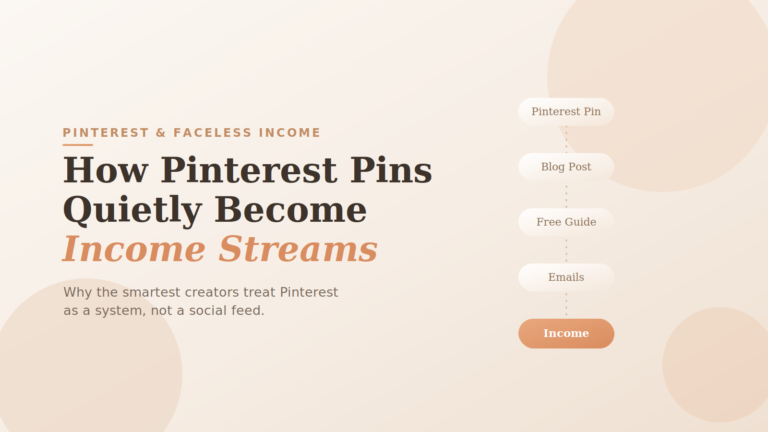
Google or Pinterest → Blog post → Email opt-in → Helpful emails → Relevant offer
For example:
- Someone finds your article through Google.
- The article answers their beginner question.
- They download your checklist.
- Your welcome emails provide additional help.
- One email introduces a suitable tool or product.
- The reader decides whether it is right for them.
Not every reader will subscribe or purchase. That is normal.
Your goal is to make the journey clear and helpful, not to pressure every visitor into buying.
Step 10: Create a Realistic Publishing Schedule
Consistency matters, but an unrealistic content plan usually leads to burnout.
If you are working alone, start with a schedule you can maintain.
For example:
- One in-depth SEO article per week
- Three to five Pinterest pins for each article
- One email per week
- One monthly content update
- One small product improvement per month
A single useful article is better than five rushed posts created only to meet a schedule.
Quality matters especially when your brand cannot rely on a personal following to create immediate attention.
Step 11: Track the Right Results
Do not judge the business only by followers.
Track metrics connected to your actual goals:
- Search impressions
- Website visitors
- Keyword rankings
- Email subscribers
- Landing-page conversion rate
- Email clicks
- Affiliate-link clicks
- Product sales
- Revenue by content page
In the beginning, progress may look like:
- Publishing your first five useful articles
- Receiving your first organic impressions
- Getting your first email subscriber
- Earning your first affiliate click
- Learning which topic attracts the right readers
Those signals help you decide what to create next.
Common Faceless Business Mistakes
Choosing a niche only because it looks profitable
A topic may appear profitable but still be difficult to sustain if you dislike researching or creating content about it.
Look for a balance between audience demand, monetization, and your ability to continue.
Copying successful faceless accounts
You can study topics and formats, but copying another brand’s articles, graphics, or positioning will not create a durable business.
Build your own content library and point of view.
Using AI without adding value
AI can help with research, outlines, editing, and workflow. It should not replace fact-checking, firsthand judgment, or a clear content strategy.
Generic content is easy to create and easy to ignore.
Starting on too many platforms
You do not need a blog, newsletter, YouTube channel, TikTok account, Instagram account, podcast, and five digital products at the same time.
Build one working system before adding another.
Hiding affiliate relationships
Clearly disclose when your content contains affiliate links. Transparency helps readers make informed decisions and protects trust.
Expecting immediate passive income
A faceless business can eventually become more systemized, but it still requires research, content creation, testing, maintenance, and customer understanding.
“Faceless” describes how the brand appears. It does not remove the work required to build it.
A Simple 30-Day Faceless Business Plan
If you feel overwhelmed, use this basic sequence.
Week 1: Build the foundation
- Choose one audience
- Identify one main problem
- Select a business model
- Choose a brand name
- Define your basic visual style
Week 2: Set up the platform
- Create your website or blog
- Open your email-marketing account
- Create one landing page
- Prepare one simple lead magnet
- Write your welcome email
Week 3: Create the first content
- Research beginner keywords
- Write your first in-depth article
- Create supporting graphics
- Add a relevant email opt-in
- Test every link and form
Week 4: Publish and learn
- Publish your article
- Submit it to Google Search Console
- Share it through your primary traffic source
- Review initial impressions and clicks
- Plan the next three related articles
You do not have to complete every task perfectly. The goal is to create a functioning first version.
What Tools Do You Need?
You can start with a small toolkit.
WordPress
Use WordPress to publish search-optimized blog content and build a long-term content library.
Systeme.io
Use Systeme.io to create landing pages, capture subscribers, send emails, and build basic automations.
Its free plan currently includes core features suitable for testing a beginner funnel. Plan limits can change, so review the current terms before choosing a platform.
Create your free Systeme.io account →
Canva
Use Canva to create featured images, Pinterest graphics, lead magnets, and simple product mockups.
Google Search Console
Use Search Console to monitor indexing, search impressions, clicks, and queries that bring people to your website.
Do not purchase a large stack of tools before you know what your business actually needs.
Start With a Clear Plan, Not More Information
Starting a faceless online business can feel complicated because there are so many possible niches, platforms, products, and strategies.
But your first version can be simple:
- One audience
- One problem
- One business model
- One primary content platform
- One traffic source
- One email funnel
- One relevant offer
Once that system is working, you can add more content, products, platforms, and automation.
If you need help organizing your niche, content direction, monetization path, and first action steps, the Faceless Income Starter Blueprint gives you a clearer place to begin.
Explore the Faceless Income Starter Blueprint →
When you are ready to build the system behind your content, you can start with Systeme.io for free.
Build your first faceless business funnel →
Still deciding which business model fits you? Explore these 12 faceless business ideas for beginners.
Frequently Asked Questions
Can I start an online business without showing my face?
Yes. You can build a business using written content, branded graphics, screen recordings, voiceovers, digital products, curated resources, and email marketing. You still need to build trust through useful and consistent work.
Is a faceless online business anonymous?
Not necessarily. Your public brand can remain faceless, but payment processors, banks, tax authorities, affiliate platforms, and other service providers may require your legal identity.
Which faceless business model is best for beginners?
Affiliate blogging and small digital products can be beginner-friendly because they do not require personal videos or physical inventory. The best choice depends on your skills, audience, and preferred content format.
How much does it cost to start a faceless business?
Costs vary by model. You can begin with free or low-cost tools, but you may eventually pay for a domain, website hosting, email software, design tools, or product delivery. Avoid spending heavily before validating your direction.
How long does it take to make money?
There is no guaranteed timeline. Results depend on the niche, content quality, traffic source, offer, consistency, and audience demand. SEO-based businesses commonly require patience because new content may take time to rank.
Can I use AI to create faceless content?
Yes, AI can assist with ideas, research, outlines, editing, and repurposing. You should review accuracy, add original insight, follow platform rules, and avoid publishing unedited generic content.
Do I need social media?
No, but you need a way for people to discover the business. You could use SEO, Pinterest, social platforms, partnerships, communities, or paid advertising. Start with one primary traffic source.
Do I need an email list?
An email list is strongly recommended because it allows you to communicate with interested readers without depending entirely on search or social-media algorithms.
One Comment