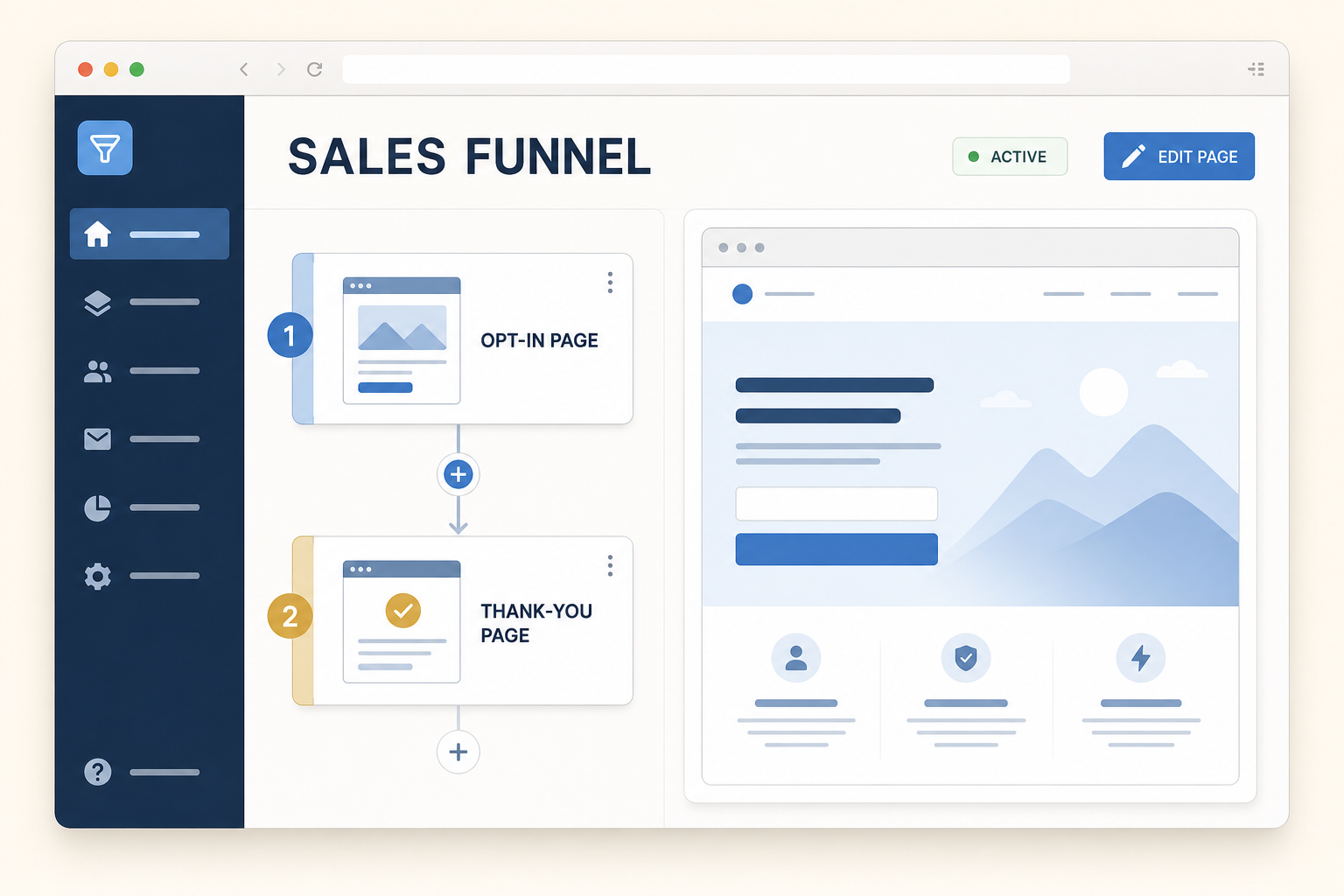
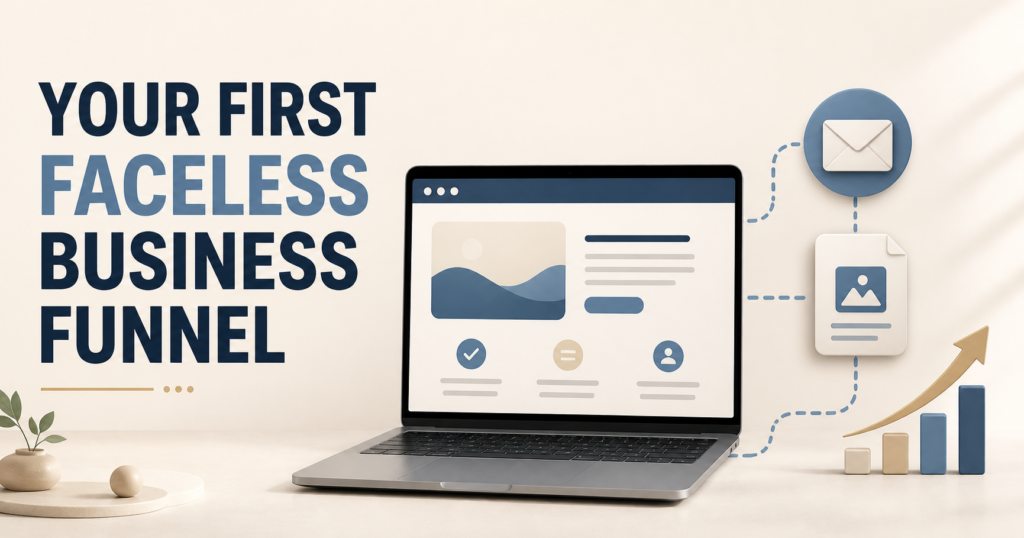
How to Build Your First Faceless Business Funnel for Free
You do not need expensive software, a complicated website, or a personal brand to build a funnel that works.
If you are starting a faceless online business, your first funnel should be simple.
It does not need seven pages, advanced automations, or dozens of emails. You only need a clear path that turns a stranger into a subscriber—and gives that person a useful next step.
In this guide, you will learn how to build your first faceless business funnel for free using Systeme.io.
By the end, you will have the basic structure needed to:
- Attract the right audience
- Collect email addresses
- Deliver a useful free resource
- Recommend a relevant product or service
- Continue the conversation through email
No coding or previous funnel-building experience is required.
Affiliate disclosure: This article contains affiliate links. If you sign up or make a purchase through one of my links, I may earn a commission at no additional cost to you. I only recommend tools that I believe can genuinely help beginner online business owners.
What Is a Faceless Business Funnel?
A faceless business funnel is a series of pages and emails that guide someone from discovering your content to taking a specific action—without requiring you to build the business around your face or personal life.
For example, someone might:
- Find one of your blog posts through Google or Pinterest.
- Click on a free checklist mentioned in the post.
- Enter their email address on a landing page.
- Receive the checklist.
- Read a short email sequence.
- Click through to a product you recommend.
That entire process can happen without personal videos, live calls, daily social media posts, or constant manual follow-up.
Your content and systems do the guiding for you.
However, “faceless” does not mean impersonal. Your funnel should still feel helpful, trustworthy, and written for a real person with a real problem.
The Simple Funnel We Are Going to Build
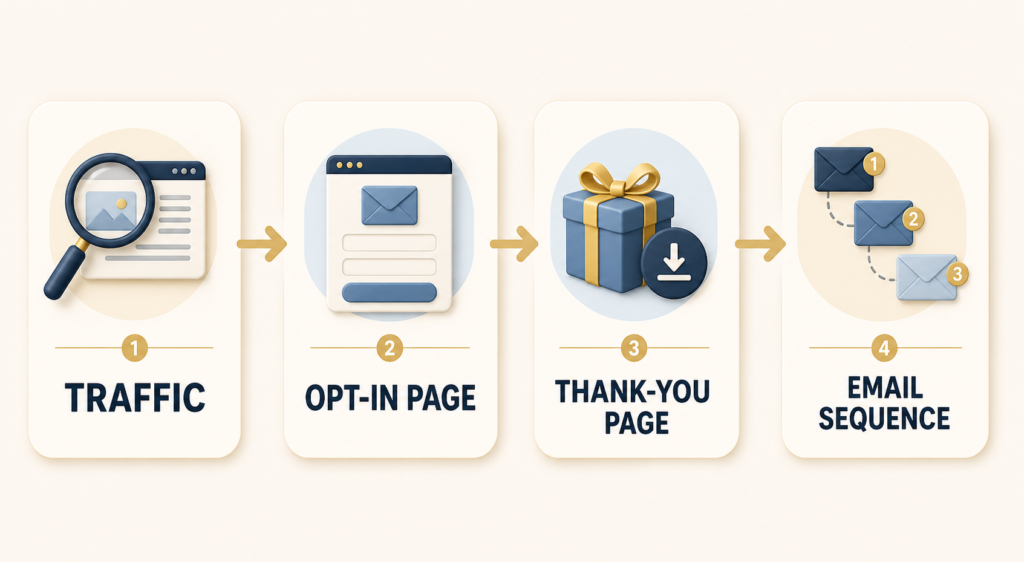
For your first funnel, you only need three core elements:
Traffic source → Opt-in page → Thank-you page and email follow-up
Here is what each part does:
- Traffic source: Brings the right people to your funnel through blog posts, Pinterest, search engines, or social content.
- Opt-in page: Offers a useful free resource in exchange for an email address.
- Thank-you page: Delivers the next step and can introduce a relevant recommendation.
- Email follow-up: Builds trust, provides additional help, and reminds the subscriber about your offer.
This is sometimes called a lead-generation funnel.
It is one of the best funnel types for beginners because it allows you to start building an audience before you have your own large product library.
Why Systeme.io Is a Good Starting Point
You could combine a landing-page builder, email service, automation tool, and course platform. But connecting several different tools can quickly become expensive and confusing.
Systeme.io brings the main pieces together in one place.
Its free plan currently includes core funnel and email features, including up to 2,000 contacts, unlimited email sending, three sales funnels, one email campaign, and basic automation. Always check the current Systeme.io pricing page because plan limits can change.
For a beginner building one simple funnel, that is more than enough to get started.
Start building your funnel with Systeme.io for free →
No credit card is required for the free plan at the time of writing.
Step 1: Choose One Problem Your Funnel Will Solve
Before opening any funnel software, decide what the funnel is about.
A common beginner mistake is trying to help everyone with everything.
A funnel works better when it addresses one specific problem for one specific type of person.
Instead of creating a general freebie called:
“How to Make Money Online”
Try something narrower, such as:
- “The Beginner’s Faceless Niche Checklist”
- “10 Digital Products You Can Create Without Showing Your Face”
- “Your First Affiliate Blog Post Template”
- “The 30-Minute Pinterest Content Planner”
- “The Faceless Business Launch Checklist”
Ask yourself:
What small but meaningful result can I help my ideal reader achieve today?
Your first funnel does not need to solve their entire business. It only needs to help them take one useful step.
Step 2: Create a Simple Lead Magnet
A lead magnet is the free resource someone receives after subscribing.
For a beginner audience, the best lead magnets are usually quick to understand and easy to use.
Good options include:
- A one-page checklist
- A short workbook
- A template
- A swipe file
- A list of tools or ideas
- A mini email course
- A simple step-by-step roadmap
Avoid creating a 70-page ebook for your first funnel. Most people do not need more information—they need a clearer next action.
Aim to create something your subscriber can use in 10 to 20 minutes.
A strong lead magnet should be:
- Specific to your niche
- Connected to your future content or offer
- Easy to consume
- Useful even if the subscriber buys nothing
If you are still working out your niche, offer, content plan, and first income path, the Faceless Income Starter Blueprintcan help you organize those foundations before you add more tools.
[Explore the Faceless Income Starter Blueprint →]([BLUEPRINT LINK])
Step 3: Create Your Free Systeme.io Account
Go to Systeme.io and create your free account.
Create your free Systeme.io account →
Once you are inside the dashboard:
- Open the Funnels section.
- Select Create.
- Give your funnel a clear internal name.
- Choose the option for building an audience or collecting emails.
- Select the currency you expect to use if prompted.
Do not spend too much time choosing the perfect funnel name. Visitors will not see the internal name.
Something like “Beginner Lead Magnet Funnel” is enough.
Step 4: Build Your Opt-In Page
Your opt-in page has one job: persuade the right visitor to exchange their email address for your lead magnet.
Keep this page focused. Avoid menus, multiple offers, unrelated links, and long introductions.
A beginner-friendly opt-in page needs five elements.
1. A clear headline
State the result the visitor will receive.
For example:
Start Your Faceless Business With a Clear, Beginner-Friendly Plan
2. A supporting sentence
Explain who the resource is for and what it helps them do.
For example:
Download the free checklist and discover the essential steps for choosing your niche, creating content, and building your first simple income system.
3. Three to five benefit points
Tell the visitor what is inside or what they will learn.
For example:
- Choose a realistic faceless business model
- Avoid the tools you do not need yet
- Plan your first pieces of strategic content
- Identify a simple monetization path
4. An email form
Ask only for the information you need.
An email address is usually enough. Adding more fields can create unnecessary friction.
5. One specific button
Use button text that describes what happens next.
Better button text includes:
- Send Me the Free Checklist
- Get the Free Guide
- Show Me the Blueprint
- Start My Faceless Business
“Submit” is technically accurate, but it gives the reader no reason to click.
Step 5: Create a Useful Thank-You Page
After subscribing, your visitor should arrive on a thank-you page.
Do not leave this page blank or rely only on a generic “Thank you” message. At this moment, the subscriber is already paying attention and is likely to take another small action.
Your thank-you page should:
- Confirm that the subscription worked.
- Explain where to find the lead magnet.
- Ask the subscriber to check their spam or promotions folder.
- Introduce one relevant next step.
That next step might be:
- Reading a related blog post
- Exploring your starter blueprint
- Trying the tool needed to implement the lesson
- Following your Pinterest account
- Replying to your welcome email
If your lead magnet teaches readers how to plan a faceless business, Systeme.io is a natural recommendation for building the funnel and email system behind it.
Example thank-you-page copy:
Your free guide is on its way.
Check your inbox in the next few minutes. While you wait, you can create the free account you will need to build your first landing page and email sequence.
The recommendation should feel like the logical next step—not an unrelated sales pitch.
Step 6: Write Your First Welcome Email
Your first email should arrive immediately after someone subscribes.
Keep it short and useful.
Include:
- A friendly welcome
- A link to the promised resource
- One sentence about what they can expect from you
- One simple next action
Here is a basic structure:
Subject: Your [lead magnet name] is here
Hi,
Thanks for downloading [YOUR LEAD MAGNET NAME].
You can access it here:
[Download the guide →]([LEAD MAGNET LINK])
Start with the first step and keep it simple. You do not need to build your entire business this week.
Over the next few days, I will send you a few practical ideas to help you turn your faceless-business plan into a system you can actually use.
For now, your next step is to choose the one audience and problem you want your first funnel to serve.
Talk soon,
XXXX
P.S. When you are ready to build the funnel, you can [create a free Systeme.io account here] SYSTEME.IO
Step 7: Add a Short Email Sequence
You do not need 20 emails.
Begin with three to five messages that help your subscriber move from interest to action.
A simple sequence could look like this:
Email 1: Deliver the resource
Send the lead magnet immediately and explain the first step.
Email 2: Solve one small problem
Address a beginner question or common obstacle.
Example topic:
Why you do not need the perfect niche before you start
Email 3: Correct a common mistake
Help the reader avoid unnecessary complexity.
Example topic:
The funnel mistake that keeps beginners stuck in planning mode
Email 4: Introduce the tool
Show how Systeme.io helps them put the process into practice.
Focus on the problem the tool solves—not on listing every available feature.
Email 5: Offer the next level of support
Invite readers who want a more complete roadmap to explore the Faceless Income Starter Blueprint.
Each email should have one main purpose and one main CTA.
Step 8: Connect Your Automation
Your automation tells Systeme.io what to do after someone completes the form.
For a simple funnel, the process can be:
Visitor subscribes → Subscriber enters email campaign → Welcome email is sent
Inside Systeme.io, create an automation rule using the funnel-form subscription as the trigger and enrollment in your email campaign as the action.
The exact labels in the dashboard may change over time, but the logic remains the same:
- Trigger: A person subscribes through your funnel.
- Action: Add that person to your welcome campaign.
Test this with your own email address before sending traffic to the page.
Confirm that:
- The form accepts the email address.
- The thank-you page loads.
- The welcome email arrives.
- The download link works.
- The buttons lead to the correct pages.
- The emails display properly on mobile.
Step 9: Add Traffic to Your Funnel
A funnel cannot work without visitors.
For a faceless beginner business, you can start with one sustainable traffic source instead of trying to post everywhere.
SEO blog content
Write articles targeting questions your ideal reader already searches for.
Examples include:
- How to start a faceless online business
- Best faceless niches for beginners
- How to create a digital product anonymously
- Best free tools for faceless creators
- How to start affiliate marketing without showing your face
Place your lead magnet naturally inside related articles.
Create simple pins that lead to your blog posts or opt-in page. Pinterest can work particularly well for visual, educational, and evergreen topics.
Search-friendly social content
Create short tutorials, carousels, text posts, or screen recordings that answer one specific question and direct interested viewers to the full resource.
You do not need viral traffic.
Ten relevant visitors are more valuable than 1,000 people who have no interest in the problem your funnel solves.
What to Track After Publishing
Do not rebuild your funnel every few days.
Give it enough traffic to identify a genuine pattern.
Start by tracking:
- Number of landing-page visitors
- Number of subscribers
- Opt-in conversion rate
- Email open rate
- Email click rate
- Clicks on your primary offer
- Affiliate conversions or product sales
If people visit but do not subscribe, review the lead magnet and headline.
If people subscribe but do not open your emails, review your subject lines and email deliverability.
If people open but do not click, make the next step clearer and more relevant.
Change one important element at a time so you know what caused the result.
Common Beginner Funnel Mistakes
Adding too many offers
Your first funnel should guide the visitor toward one main outcome. Five competing buttons usually create confusion rather than opportunity.
Choosing a broad lead magnet
A specific resource attracts a more relevant subscriber.
“50 Online Business Ideas” may attract curiosity. “The Beginner’s Faceless Affiliate Blog Checklist” attracts someone with a clearer goal.
Overdesigning the landing page
Clear copy and an obvious CTA matter more than animations, complicated layouts, or perfect branding.
Promoting before testing
Always complete the funnel yourself using both desktop and mobile devices.
Expecting the funnel to create instant passive income
A funnel is a system, not a guarantee. It still needs relevant traffic, useful content, trust, testing, and a suitable offer.
Waiting until everything is perfect
Your first version is supposed to teach you what your audience responds to.
Publish the simple version. Improve it with real information later.
Your First Funnel Does Not Need to Be Complicated
A functional faceless business funnel can be surprisingly small:
- One helpful lead magnet
- One opt-in page
- One thank-you page
- One short email sequence
- One relevant offer
- One consistent traffic source
That is enough to begin building an audience and learning what people need from you.
You can expand the system after it starts working. You might later add more content, segmentation, products, email sequences, or advanced automation.
But you do not need any of that to publish version one.
Build your first funnel with Systeme.io for free →
If you need help deciding what your faceless business should offer, how your content connects to income, and what to build first, use the Faceless Income Starter Blueprint as your next step.
Get the Faceless Income Starter Blueprint →
Frequently Asked Questions
Can I build a sales funnel for free?
Yes. Systeme.io currently offers a free plan with funnel-building, email-marketing, and basic automation features. The free-plan limits may change, so check the official pricing page before publishing or making a platform decision.
Do I need a website to build a funnel?
No. A funnel can work independently of a traditional website. You can create a landing page, thank-you page, and email sequence first, then add a full website or blog later.
A WordPress blog can still be valuable because it gives you a place to publish search-optimized content that sends relevant traffic into your funnel.
Can I create a funnel without showing my face?
Yes. Your funnel can use written copy, branded graphics, product mockups, screenshots, stock images, or simple illustrations. You do not need personal photos or videos unless they support your strategy.
What should I offer as a lead magnet?
Choose a small resource that solves one specific problem for your ideal reader. Checklists, templates, short guides, planners, and swipe files are all beginner-friendly options.
How many emails should my first funnel include?
Start with three to five emails. Deliver the resource, answer a common question, solve a small problem, introduce a relevant tool or offer, and explain the next step.
Is Systeme.io suitable for beginners?
Systeme.io is designed as an all-in-one platform for funnels, email marketing, automation, courses, and online selling. Keeping these functions in one platform can reduce the number of tools a beginner needs to configure.
How long does it take to build a simple funnel?
If your lead magnet and copy are ready, you may be able to create a basic funnel in an afternoon. Give yourself additional time to test every form, link, email, and mobile page before promoting it.
Before building your funnel, choose one of these beginner-friendly faceless business ideas.
2 Comments